Prologue
The Imperfection
Ruby baked cinnamon rolls so uniform that geometry teachers fell silent at the sight of her trays. Every spiral turned with the same composure, every ribbon of icing stopped at precisely the point where it looked tempting without losing its dignity, and even the cinnamon seemed to obey the rules in her bakery.
That morning, Ruby rose shortly after five. Goldhain was still asleep. Only the little bakery showed a light, and Goldie lay on her blanket beside the flour sack as though she were working the night shift.
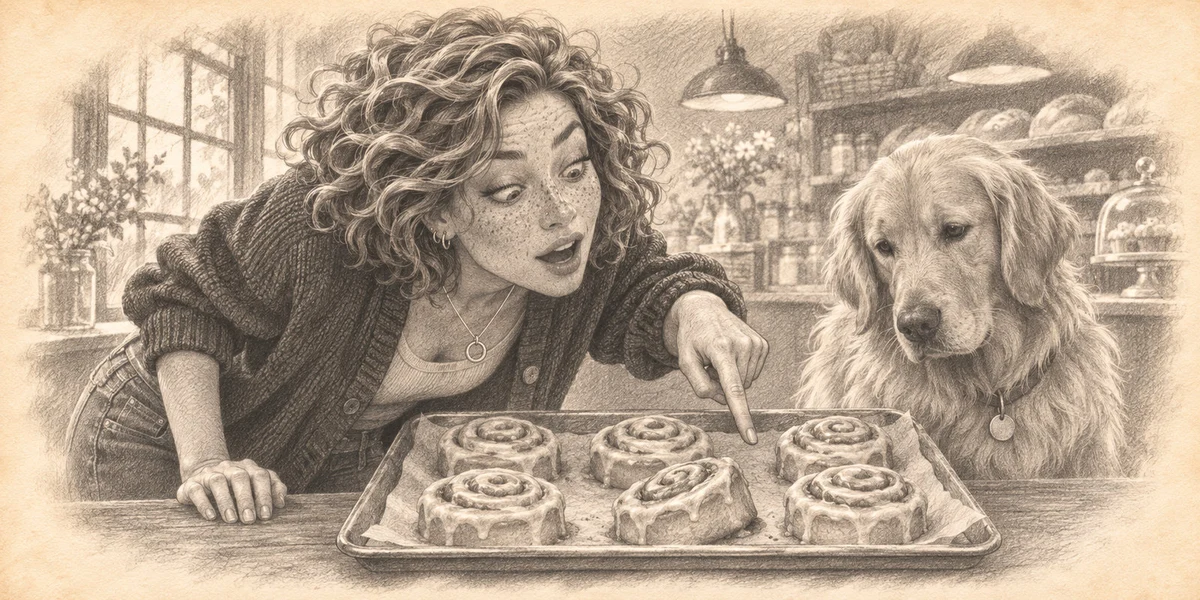
Ruby opened the oven. Warm air moved through her copper-red hair. Six cinnamon rolls sat on the tray.
Five were perfect.
The sixth spiralled to the left.
Ruby bent closer. Goldie lifted her head. Together they regarded the deviation.
"You can see it too," said Ruby.
Goldie blinked.
The roll was neither burnt nor underbaked. It smelt wonderful. But its outer coil made a small, self-assured curve, as though the dough had developed an opinion of its own just before going into the oven.
Ruby extended one finger but did not touch it. "That is merely a test piece."
Goldie placed one paw on the edge of the worktable.
"No." Ruby moved the tray away. "You are not quality control."
Goldie looked at her in a way that asserted the opposite.
Ruby set the tray aside and took down a fresh bowl. If one batch of dough refused to hold its shape, she would simply make another.
That was how the uprising began.
I.
A Second Attempt
Ruby weighed flour, milk, butter and sugar. She worked without errors, without haste and without the little improvisations by which other people turned recipes into personal adventures. Her hands knew the movements. The bakery knew the rhythm.
Only the yeast seemed unusually lively.
When Ruby dissolved it in the warm milk, bubbles formed. Not many. Just a few. One burst with a quiet sound suspiciously like a sigh.
"We are doing this properly today," said Ruby.
Goldie changed places. She settled beneath the window, far enough from the bowl to make a credible claim of ignorance later.
Ruby kneaded the dough until it was smooth. She shaped it into a ball, placed it in the bowl and covered it with a cloth. Then she set the whole arrangement beside the warm oven.
"Forty minutes," she said.
After ten minutes, the cloth began to rise.
After fifteen, the bowl appeared to be wearing a very round hat.
After twenty, the cloth slid to the floor. The dough bulged over the rim and remained there, soft and pale but unmistakably determined.
Ruby planted her hands on her hips. "Back."
The dough did not respond.
She took a wooden spoon and carefully pressed it down. The dough yielded. For a moment, order seemed to have been restored.
Then it wrapped itself around the spoon.
II.
The First Countermeasure
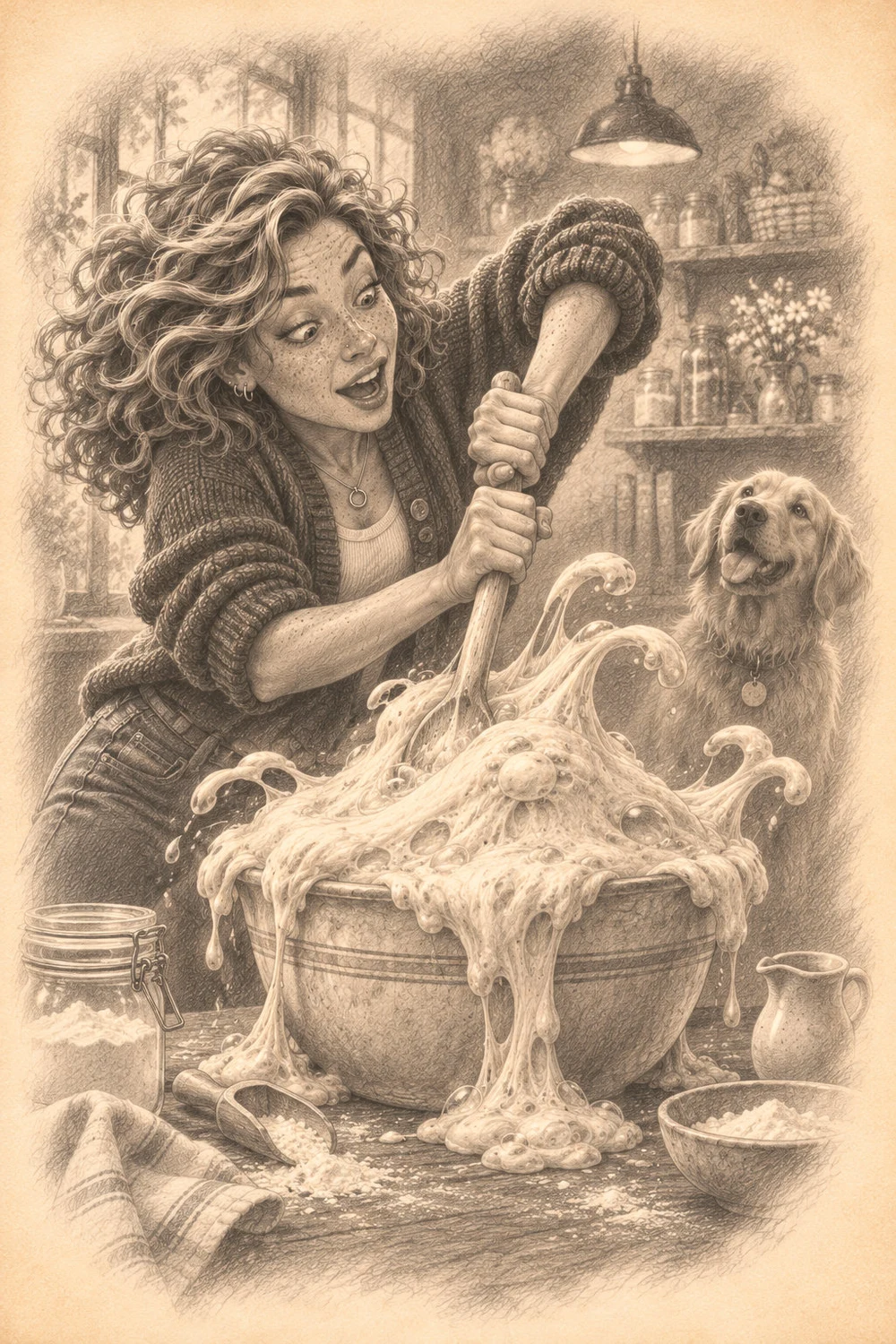
Ruby pulled. The dough pulled back.
It was not a movement any reasonable dough should have made. Nor was it a quick movement. That was what made it so insulting. The mass coiled around the wooden spoon with the slow certainty of a climbing plant while Ruby closed both hands around the handle and braced herself against the worktable.
"You are flour with ambitions," she said through clenched teeth. "Nothing more."
Goldie was standing now, her tail wagging cautiously. Perhaps she thought the scene was a game. Perhaps she was considering a rescue. More probably, she was hoping something edible would fall.
With one final tug, Ruby freed the spoon. The dough collapsed back into the bowl. One small strand remained stuck to the wood and fluttered like a white flag.
Ruby breathed out.
Then the dough began to rise again.
She fetched the largest bowl from the shelf. The mass moved into it. Ruby covered it with a heavier cloth and placed a tin on top. The lid lifted. She added a cookbook. The stack tilted. Finally, she set the cast-iron doorstop on top of everything.
Silence.
Ruby washed her hands. "See? Physics."
Goldie looked towards the stack of bowls.
The doorstop rose by one centimetre.
Ruby turned her head very slowly.
"Insolent."
She added two heavy baking tins. The stack now swayed so alarmingly that Ruby stepped back and studied it through narrowed eyes. In a reasonable world, weight would have won at this point. The bakery, however, stood in Goldhain, where reason was regarded as a friendly suggestion.
A bulge formed beneath the cloth. It travelled slowly from left to right, apparently assessing the situation, then pushed the cookbook half a centimetre sideways.
Goldie rose, took her blanket between her teeth and dragged it behind the counter.
"Don't be dramatic," said Ruby.
Goldie lay down on the blanket and stared at the ceiling as though she could not possibly be connected to the incident.
Ruby fetched string. She tied bowl, cloth, cookbook and doorstop into a structure that looked less like baking preparation than the securing of rare cargo. When she pulled the final knot tight, everything remained still.
Ruby waited ten seconds. Then twenty.
"Good," she said.
From inside came a muffled pop.
The knot held. The bowl jumped forward by the width of a finger anyway.
Without a word, Ruby picked up the flour sack and placed it in front of the door.
III.
Flour Storm over Goldhain
The bakery normally opened at six for the first commuters. That morning, the door remained locked. Through the window, Ruby could be seen rushing past, first carrying a bowl, then two baking trays, and finally a sack of flour that she positioned in front of the oven like a sandbag.
Inside, the dough had reached the worktop.
It poured out of the bowl, stretched a soft arm across the wood and caught the edge of the flour sieve. The sieve tipped. A white cloud rose.
Ruby coughed. Goldie sneezed so forcefully that she backed into a basket. The basket toppled. Cinnamon sticks rolled across the floor.
Within seconds, the bakery became a landscape of flour fog, sugar hills and brown trails of spice. Ruby tied a cloth over her mouth and nose. Her dark cardigan was powdered white, and her freckles were barely visible.
"That is enough."
She divided the dough into four pieces and put each piece on its own tray. Four smaller problems, she hoped, would be easier to manage than one large one.
All four pieces rose at once.
Goldie sat behind the sugar sack and watched four problems become eight.
Ruby picked up the phone and called Lena.
"I need a second opinion."
"Technical or moral?" Lena asked sleepily.
Ruby looked at the dough, which was in the process of swallowing a measuring jug.
"Both."
While she waited, Ruby began an inventory. Two trays were lost, one only temporarily. The measuring jug was half embedded in the dough but could probably be rescued. Three cinnamon sticks had barricaded themselves beneath a cabinet. Goldie was unharmed, though firmly convinced that she was entitled to danger pay.
Ruby wrote everything on the back of a bread bag. Under Damage, she listed: Flour. Order. Dignity.
Then she crossed out dignity. There would be time for that later.
IV.
The Council of Experts
Lena arrived with a notebook and her glasses. Lin arrived with a tool bag, safety goggles and a degree of enthusiasm that made Ruby suspicious at once.
"It is not alive," Ruby said before anyone could ask.
Lin knelt beside the largest piece of dough. "It does react."
"Yeast always reacts."
"This one is waving."
A small bulge did indeed rise at the edge of the mass. Then it sank again. Lena wrote something down.
Ruby did not snatch the notebook from her. She merely considered it for a moment.
Together they checked the temperature, ingredients and quantities. Everything was correct. The yeast was fresh, the milk not too warm, the flour the same as always. Lin suggested monitoring the dough with a small sensor. Ruby suggested baking it.
"In which oven?" asked Lena.
By now, the dough had joined three trays together and was beginning to form a fourth level.
They developed a plan. Lena calculated portions. Lin built a system of barriers from baking frames and clamps. Ruby greased tins and began cutting off pieces.
For seven minutes, everything worked.
Then the dough pushed up the first baking frame. The clamp flew through the air and landed in Goldie's water bowl.
Lin smiled with delight. "We need stronger clamps."
Ruby looked at her. "We need breakfast."
V.
The Cinnamon Battle
Ruby rolled out the first strip of dough. It contracted. She rolled it again. It contracted again. A silent duel began between craftsmanship and elasticity.
Lena held one corner. Lin scattered flour. Goldie guarded the sugar by sitting in front of it and pretending not to be interested.
Ruby spread butter over the dough, added cinnamon and sugar, and began to roll. The cylinder grew thicker, longer and surprisingly heavy. When she set the knife against it, the far end snapped back and left a brown streak of cinnamon across the wall.
"That was deliberate," said Lin.
"No," said Ruby.
They cut. The first slice was round. The second was oval. The third possessed a bulge that looked like an ear. The fourth folded in the middle and appeared to have fallen asleep.
Ruby placed each one on the tray. No two were alike.
"We could sort them," Lena suggested.
"By shape?"
"By emotional effect."
Ruby lifted the fifth roll. Its spiral ended in a small point.
"That one is offended," said Lin.
Goldie seized the moment, pulled the sugar spoon from the table and was officially dismissed from quality control for the first time.
VI.
The Customers Wait
A queue had formed outside the door. The people were patient, but the scent escaping from the bakery was making patience visibly difficult.
Ruby wiped flour from her face and opened the door a crack.
"Slight delay."
"How slight?" asked the first customer.
Behind Ruby, a tray fell over. Lin called, "Everything is under control!" Lena called, "That is not entirely true!"
Ruby closed the door again. "Manageable."
The first trays went into the oven. The rolls swelled, but this time the heat limited their ambition. Cinnamon and butter melted together. The scent became so warm and dense that it slipped through the crack beneath the door and out into the street.
When Ruby removed the first tray, she saw the result.
Not one roll was perfect.
One leaned to the side. One had risen into two spirals. One had a little point. The one with the ear now resembled a grumpy mayor.
They tasted excellent.
Ruby tried one corner. The crust was soft, the cinnamon strong and the centre moist.
"We can sell them," said Lena.
Ruby looked towards the window, beyond which the customers were waiting. "Like this?"
Lin took the roll with the little point. "Exactly like this."
VII.
The First Selection
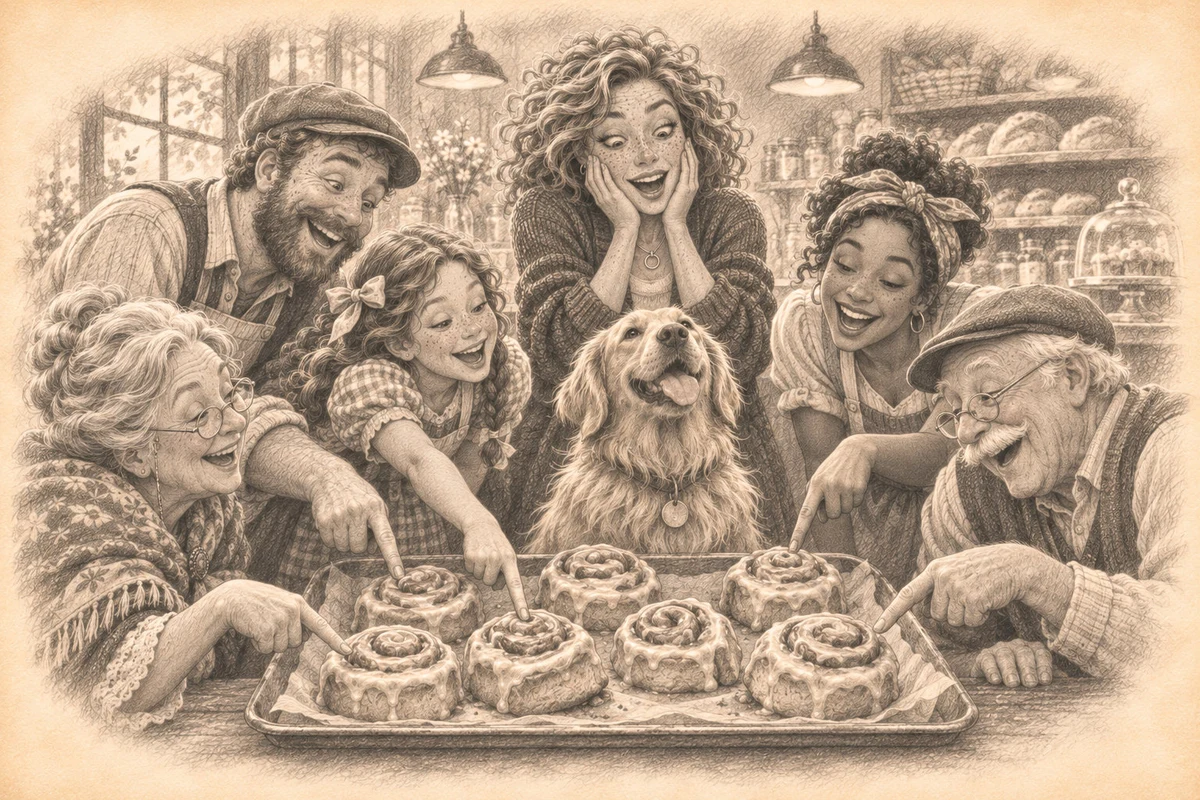
Ruby set the tray on the counter and opened the door.
The customers came in. For a moment, no one spoke. Ruby stood behind the uneven rolls and felt as though she were presenting a school class that had decided to pull faces on picture day.
"They are not entirely... uniform today," she began.
An elderly woman bent over the tray. "Which one has the most cinnamon?"
Ruby pointed to the one whose spiral had almost fallen apart. The woman took it.
A boy chose the one with the ear. A man in work clothes wanted the largest, even though it was crooked. A young woman selected the smallest because it "looked as if it had tried its best".
Suddenly everyone was talking at once. Each person discovered a different roll. They compared shapes, invented names and argued cheerfully about whether the divided spiral looked more like a butterfly or a moustache.
Ruby watched the tray empty.
A girl in a yellow raincoat stood particularly long before the final three rolls. She pointed to one that had turned out slightly flatter at the edge and was leaning its small spiral against a larger one.
"That one," she said.
"It isn't the biggest," her father observed.
The girl shook her head. "But it looks brave."
Ruby placed the roll in a bag. The girl accepted it in both hands as though she were being given a medal. Ruby watched until the yellow hood disappeared beyond the window.
After that, she stopped straightening the remaining rolls.
"One more," someone said.
"The grumpy one," another demanded.
Goldie sat behind the counter with a patch of flour on her nose like a service badge.
Ruby fetched the next tray.
VIII.
The Mayor
Around midday, the mayor appeared in person. He had heard that one of the cinnamon rolls resembled him. In Goldhain, this was sufficient reason for an official appointment.
Ruby placed the relevant roll on a plate. It had a broad centre, an upturned fold of dough and a dark line of cinnamon that genuinely resembled a moustache.
The mayor put on his glasses. He regarded the pastry. The pastry did not regard him in return, yet somehow seemed critical.
"The resemblance is remarkable," said Lena.
Ruby discreetly stepped on her foot.
The mayor turned the plate. "Can it be eaten?"
"That is the usual purpose," said Ruby.
He took a bite. Everyone waited.
His face relaxed. "Excellent."
He bought the roll and two others, then ordered a tray of "representative shapes" for the next council meeting. Ruby explained that shapes could not be guaranteed today.
"Then we shall take whatever democracy produces," he said.
As he left, the customers applauded. Not loudly, but sufficiently to establish the roll as a local celebrity.
Ruby leaned against the counter. The day had developed from a baking mishap into a municipal event.
IX.
The Dough in the Cellar
That afternoon, Ruby remembered the original problem.
A quantity of dough remained in the cold room. She had placed it there because low temperatures were supposed to slow the yeast. When she opened the door, the bowl was empty.
A broad trail crossed the floor towards the cellar stairs.
Ruby called for Lena and Lin. Together they followed it. Goldie followed them, although no one had invited her.
The cellar was dark. A soft, damp sound came from among the flour sacks and jam jars. Lin switched on her torch.
The dough had wrapped itself around an old wine rack. It had not grown any larger. It had merely changed location and demonstrated an impressive talent for self-organisation in the process.
Ruby folded her arms. "You are coming with me now."
Lena raised one eyebrow. "You are talking to it."
"It started it."
They carefully loosened the mass from the rack. The dough was surprisingly easy to carry. Almost as though it had used up all its resistance.
Upstairs, Ruby laid it on the worktop. It remained there.
For the first time that day, it looked like ordinary dough.
X.
The Largest Roll
Ruby could have thrown the remainder away. No one would have blamed her. The bakery was full, the trays were empty, and the day had produced enough pastries to count as a success.
But Ruby looked at the dough and thought of the crooked roll from that morning.
She rolled out the mass. This time it did not contract. She spread butter across it, added cinnamon and sugar, and rolled slowly without fighting the shape.
The cylinder grew large. Too large for ordinary slices.
"Just one," said Lin.
Ruby nodded.
They shaped it into one enormous spiral and placed it in the largest round tin in the bakery. Ruby put it into the oven. Through the glass, they watched it rise. Not evenly. Not predictably. But beautifully.
When Ruby removed the tin, the roll was as large as a cartwheel. Its spiral wandered irregularly, with little valleys and high ridges. Icing collected in the hollows.
Goldie sat in front of it and lifted her nose.
"That is not for dogs," said Ruby.
Goldie did not accept this information, but temporarily respected the distance.
XI.
The Festival of Unequal Spirals
The giant roll was cut on the market square. Someone had put out tables. The mayor arrived with napkins, the elderly woman from that morning brought coffee, and the children gave names to the smaller rolls.
Ruby stood behind the great tray and cut pieces. Every slice was different. Some held plenty of cinnamon, others more soft dough, and a few had an especially generous share of icing. No one demanded equality.
Lena sat at the edge and had stopped taking notes. Lin had stopped talking about sensors. Goldie wore a fresh neckerchief and guarded a bowl of unsweetened dog biscuits that Ruby had baked expressly for her.
"Was it a new recipe?" one customer asked.
Ruby looked across the square. "The recipe was the same."
"Then what was different?"
Ruby thought of the lively yeast, the flying clamp, the cellar and the roll with the mayor's face.
"The dough had plans today."
The customer nodded as though this were an adequate explanation in Goldhain.
XII.
The New Rule
That evening, peace returned to the bakery. Ruby, Lena and Lin cleaned the worktops. Flour had found its way to places that had nothing to do with baking: the windowsill, behind the clock, inside a closed drawer.
Goldie slept beside the oven.
Ruby took the first crooked roll of the morning from its box. It had long since gone cold. It still spiralled to the left.
Ruby divided it into three pieces. She gave one to Lena and one to Lin. She ate the last herself.
It tasted just as good as all the others.
"Again tomorrow?" Lin asked.
Ruby gave her a look.
"The rolls," Lin explained quickly. "Not the uprising."
Ruby looked at the empty trays. "We will bake again tomorrow. But we will not sort them by shape any more."
She wrote a new rule on a card and set it on the counter: No two have to be alike.
Then she reconsidered, crossed out have to and wrote are allowed to above it.
Finale
Sold Out
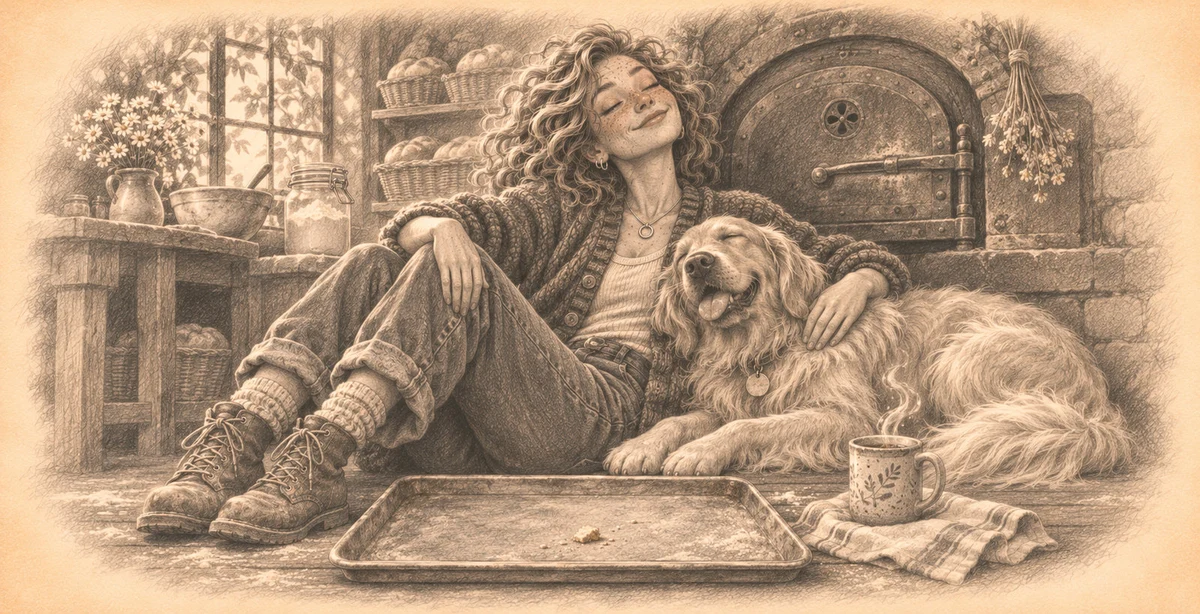
The next morning, the first customers were already waiting outside. Ruby opened on time. Three trays of cinnamon rolls stood on the counter. Some were round, some oval, and one had another little point. None looked like the mayor, which he later found mildly disappointing.
Ruby did not apologise.
She lifted the first tray. "These are particularly headstrong today."
The customers began choosing at once.
By midday, everything had sold out. The new rule hung on the door. Goldie lay beneath it accepting admiration, although her actual contribution had consisted mainly of guarding the sugar and strategically lying around.
Ruby leaned against the warm oven. Only one crumb remained on the final tray. It was not round, not symmetrical and not even where it was supposed to be.
Ruby picked it up between two fingers and ate it.
"Exactly right," she said.
At that moment, Goldie raised her head. A nearly inaudible crack came from the shelf. They both looked over.
The jar of remaining yeast stood there.
Beneath its lid, a single bubble formed.
Ruby went to the shelf, took down the jar and placed it in the furthest corner of a cabinet. Then she pushed a tin in front of it, put a cookbook on top and set the cast-iron doorstop beside it.
Goldie watched every movement.
"Purely a precaution," said Ruby.
Goldie rested her head on her paws.
From the cabinet came a very soft, very satisfied pop.
Ruby locked the door.