Prologue
Two Millimetres
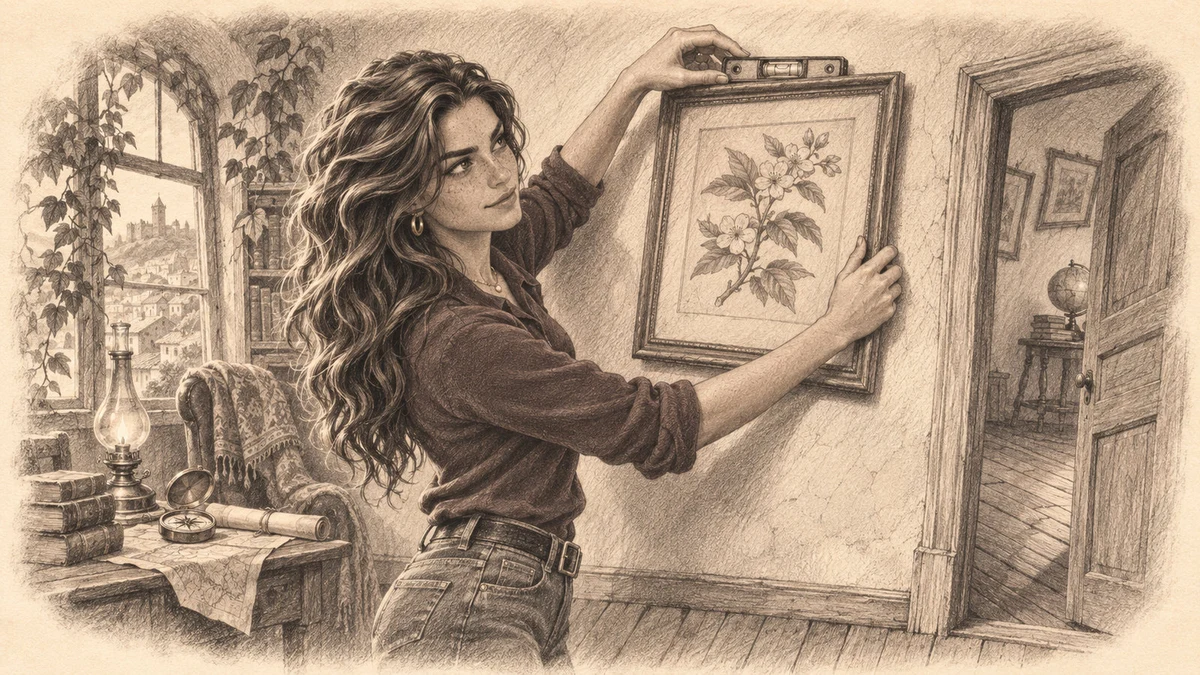
Leyla wanted to hang a picture.
It was a quiet botanical print in a narrow wooden frame: one branch, three blossoms, two carefully drawn leaves. Nothing about it called for an adventure.
The empty wall in the living room was wide enough. A single nail was already in it. Leyla picked up the frame, hung it and stepped back three paces.
The picture was crooked.
Not noticeably. Two millimetres, perhaps. The sort of flaw other people called "good enough," which was precisely why Leyla took it seriously.
She adjusted the frame to the left. Stepped back. Now it leaned to the right.
She took a small spirit level from her architecture set and placed it on top of the frame. The bubble sat exactly in the centre.
The picture looked crooked.
Leyla tested the spirit level on the table. Straight. On the windowsill. Almost straight. On the floor.
The bubble travelled all the way to the edge.
Leyla looked at the floorboards. Then the wall. Then the doorframe, which suddenly seemed to lean back with the innocence of a suspect caught in the act.
She placed both hands on the frame.
"Fine," she said. "Then we'll do it properly."
The building answered with a quiet crack.
I.
The First Measurement
Leyla began with the nail.
It sat twelve centimetres to the right of the wall's centre. That was not a problem; the empty space beside the bookcase was asymmetrical as well. But the nail pointed slightly upwards while the plaster around it sloped down.
She pulled it out, measured again and drove in a second. The frame hung from it exactly level.
It looked more crooked than before.
Leyla marked the corners in pencil. The top line was straight. The ceiling above it fell almost a centimetre towards the right. The skirting board rose six millimetres in the same direction. Between them, the picture hung correctly and therefore appeared to be the only unreasonable object in the room.
Mira came in, looked at it and tilted her head.
"Crooked," she said.
"Mathematically level."
Mira tilted her head the other way. "Then the room is crooked."
"That isn't a technical category."
"Perhaps it should be."
Leyla wrote the measurements in her notebook. The picture remained on the wall and watched her through three tranquil blossoms.
Mira went to the window and looked back from there. "Now it's straight."
Leyla stood beside her. It was. From the window, the deviation vanished. Two steps towards the middle of the room and it returned.
She marked both viewpoints with small pieces of paper on the floor. One read straight, the other crooked. In between lay a zone in which the picture visibly made up its mind.
"Perhaps it needs a sign telling people where to stand," said Mira.
Leyla did not write the suggestion down. She did, however, think about it longer than she would later admit.
II.
The Doorframe
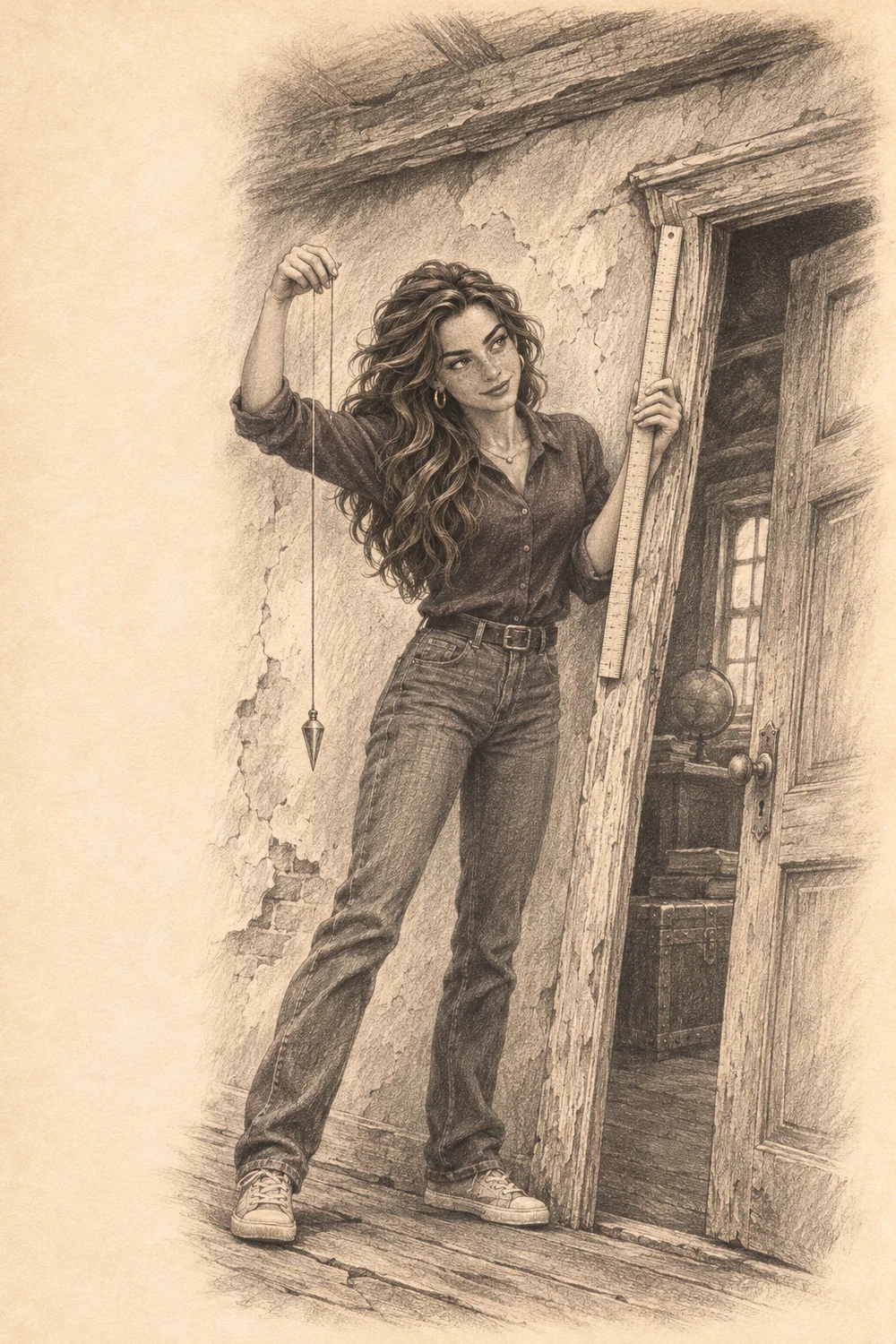
The doorframe was the clearest vertical line in the room. Leyla tested it next.
She held a plumb line beside it. The string hung straight. The frame did not.
At the top, the deviation was four millimetres; at the bottom, nine. The left side leaned inwards, the right outwards. The door itself still closed perfectly, but only because its lower edge had been cut in a gentle curve.
For years, Leyla had taken that curve for wear. Now she recognised it as a structural negotiation.
Lena came by with coffee. "What are you measuring?"
"The house's resistance to geometry."
Lena set down the cup and took the spirit level. She checked the frame, the wall, the ceiling and, finally, the table.
"Nothing agrees."
"Thank you."
"That wasn't a compliment."
"Thank you anyway."
They hung the picture parallel to the doorframe. Near the door, it looked straight; from the sofa, crooked. Parallel to the ceiling, it looked correct by the window and drunk beside the bookcase.
The room apparently possessed several truths that were not on speaking terms.
Lena fetched a protractor. This did not make the deviations smaller, only more precise. The doorframe leaned by 1.8 degrees, the skirting board by 0.9 and the ceiling by a figure that changed depending on where they measured it.
"If we average all the lines," said Lena, "we'll get an optical principal axis."
They calculated it. The result ran diagonally through the wall, cut across one corner of the frame and ended in the bookcase.
"It isn't useful," said Leyla.
"But it is correct."
"Today, those are apparently not the same thing."
III.
The Wandering Frame
By afternoon, the picture had occupied five different positions.
Above the sofa, it looked too high. Beside the bookcase, too low. Between the windows, it was straight until the curtains were opened. Above the chest of drawers, the distance on the left was right while the wall on the right suddenly contained more wall.
Leyla measured every time. She took photographs, drew guide lines and stuck little markers to the wall. Soon the living room looked like an archaeological site devoted to an exceptionally flat ruin.
Roxy came in, stopped in the doorway and surveyed the many pencil crosses.
"Are you renovating?"
"I'm hanging a picture."
Roxy considered the picture, which was currently standing on the floor. "Ambitious project."
She held it against the wall for a trial. Without measuring, she turned it slightly to the left. "Like that."
It looked straight.
Leyla put the spirit level on top. The bubble clung almost to the edge.
"That cannot be the solution."
Roxy shrugged. "It doesn't know it's wrong."
Leyla took back the frame. She was not yet prepared to replace measuring instruments with confidence.
IV.
The Survey
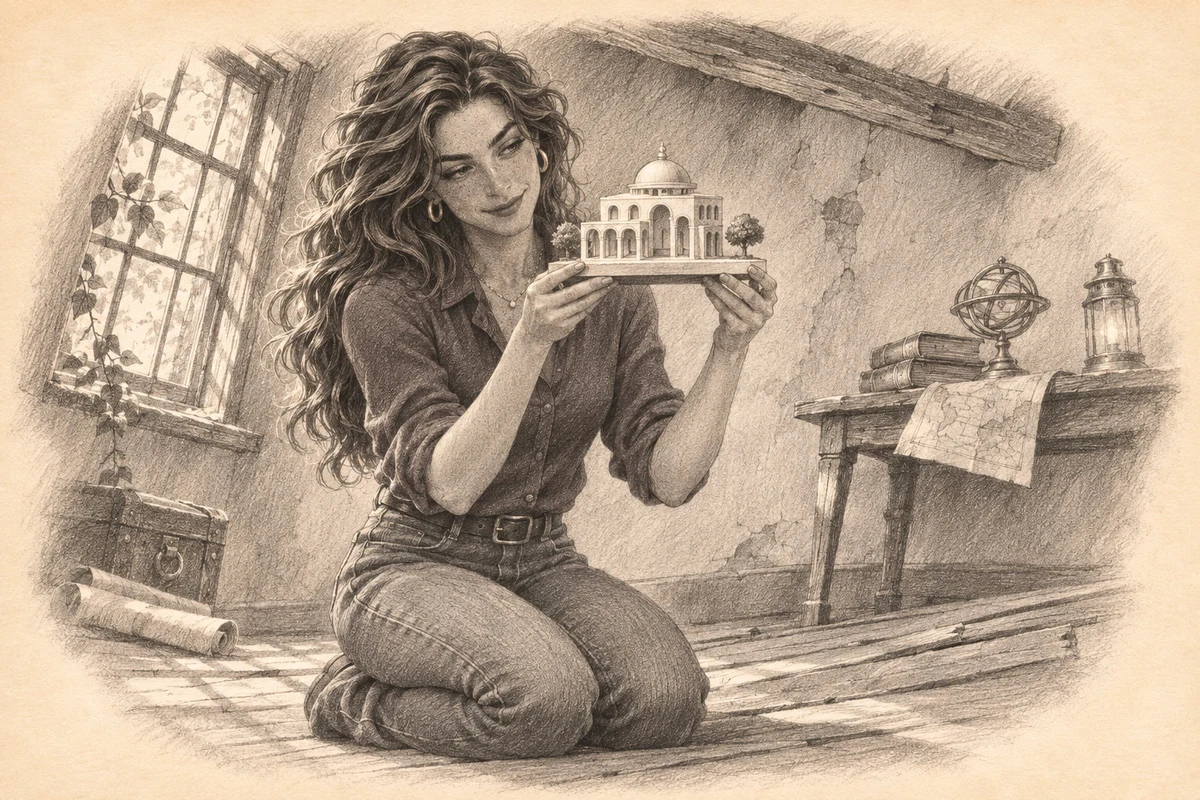
The next morning, Leyla drew a plan of the room.
She measured every wall, every angle and every window opening. The room was not a rectangle. It was not a tidy trapezium either. The north wall was five centimetres longer than the south wall, though the plans said they should be equal. One corner measured eighty-nine degrees, the opposite one ninety-two. The missing degree could not be found anywhere.
Lin brought a laser measure. The red dot travelled over the plaster and produced a different result each time.
"Is the wall moving?" Lin asked with delight.
"No."
The value changed by three millimetres.
Leyla looked at the wall. "Probably not."
They built a cardboard model of the room. At that scale, the deviations were barely visible, but the model stood firmly only when a folded piece of paper was pushed beneath one corner.
Lin placed a tiny version of the picture inside. In the model, it hung straight.
In the real room, the original still looked crooked.
"Perhaps the model is too honest," said Lin.
Leyla regarded the two rooms. For the first time, she took the conflict personally.
V.
The Historical Reason
The house was older than most straight lines in Goldhain.
In the town archive, Leyla found the original plans. The building had been erected a hundred and twenty-eight years ago as a narrow town house, then extended, divided and joined together again. The present living room consisted of parts of two former rooms and a piece of corridor.
On a plan from 1934, a staircase ran straight through the picture wall.
On an even older plan, there had been an exterior window there. Later it was bricked up, the stairs were built in front of it, and eventually both became the wall that existed today. Three phases of construction lay on top of one another like translucent memories.
The archivist brought out a yellowed photograph. A family stood in it before the old staircase. A small landscape picture hung on the wall, also crooked, though in the opposite direction.
Leyla held the photograph beside her current plan. "They had the same problem."
"Or the same solution," said Mira.
Only a date was written on the back. No complaint, no correction, no note concerning the angle.
"There was a staircase?" Mira asked.
"Inside the wall."
A conversion had removed it, but left its slope in the masonry. The ceiling beams still followed the old flight. The floor had been raised in that spot. The wall was not crooked because someone had built badly. It merely remembered a different purpose.
Leyla laid tracing paper over the plans. Lines from different decades crossed. Every one had been right in its own time.
The archivist looked over her shoulder. "Are you searching for something in particular?"
"A straight line."
He laughed. "Then you've chosen the wrong house."
Leyla took copies of the plans home.
VI.
The Counterattack
Armed with historical knowledge, Leyla returned to the wall.
She drew a new reference line: not the ceiling, floor or door, but the imagined central axis of the present room. The picture hung neatly along it. From the entrance, it looked good. From the sofa, it leaned again.
She moved the sofa eight centimetres.
Now the picture looked straight, but the rug lay crooked. She moved the rug. The chest of drawers looked wrong. She shifted the chest. The bookcase lost its relationship with the window.
Within an hour, the entire living room was in motion.
The armchair abruptly stood in front of the door, the side table blocked the window, and the rug lay diagonally because this was the only angle that agreed with both the chest and the frame. Lin tripped over a rolled corner as she entered and called the arrangement "dynamic."
Leyla photographed every variation. Everything looked even more crooked in the pictures because the camera automatically tried to correct vertical lines. Her phone recognised the room as an architectural image and offered perspective correction. Afterwards, the wall was straight but the sofa was trapezoidal.
Leyla undid the change. Some problems did not improve when software acquired confidence.
Mina appeared beneath a blanket and stopped where the sofa used to be.
"Where has my place gone?"
"The picture has to be straight."
Mina surveyed the room. "The picture doesn't have a place. I do."
She pressed the red sofa button. A new sofa appeared in exactly the old spot and pushed the displaced chest of drawers twenty centimetres to the right.
Leyla looked at her measurements.
The chest's new position suddenly made the picture appear straighter.
"That was intentional," said Mina, sitting down.
No one believed her. No one contradicted her.
VII.
The Assembly of Lines
That evening, everyone came to offer an opinion.
Lena preferred the mathematical horizontal. Mira chose the line of the ceiling because it made the room calmer. Roxy wanted the version that looked "confident." Lin proposed a motorised mount that would rotate the picture according to the viewing angle.
"No," said Leyla.
"I haven't built anything yet."
"That is why I'm saying it now."
Nika photographed the wall and placed a digital grid over it. The grid proved that not only the picture but also the window, the door and two shelves deviated. The only straight line in the room was the bottom edge of the photograph.
Mina lay on the sofa. "From here, the right side is too low."
Everyone turned the picture.
"Now the left."
They turned it back.
"Now the right again."
Leyla folded her arms. "You're moving your head."
"The building is moving my perspective."
With that, the discussion officially arrived in Absurdistan.
Jen suggested a vote. Everyone received a sticky note and was asked to mark the best position. Five minutes later, nine notes were attached to the wall. Two lay exactly on top of each other, three formed a diagonal, one had accidentally landed on the frame and Mina's was stuck to the sofa.
"That isn't a position," said Leyla.
"It's the viewpoint," said Mina.
Nika calculated the average of the marks. It lay in the middle of the picture itself, precisely on one of the drawn blossoms. No nail could go there without damaging the frame.
Democracy had failed to find a usable straight line as well.
VIII.
The Midnight Measurement
Leyla waited until the house was quiet.
Without voices, footsteps or migrating sofas, she wanted to conduct one final measurement. She stretched strings across the room, set up the plumb line and marked the shadows of the window frames.
At midnight, the picture changed.
Not really. The wood moved as the temperature fell. A floorboard creaked, the frame slid one millimetre along the nail, and the bubble in the spirit level visibly travelled to the left.
Leyla sat down on the floor.
The house was not merely crooked. It moved. Not enough to be dangerous, just enough to take every final solution personally.
She listened to pipes, beams and the wind at the window. The building was not made of rigid lines, but of materials that expanded, settled and returned.
The botanical branch in the picture continued to hang peacefully between its frame rails.
Leyla removed the spirit level.
For the first time, she did not ask: What is straight?
She asked: What belongs here?
She switched off the main light and turned on only the small lamp by the armchair. The frame's shadow fell at an angle across the wall, but the drawing inside became warm and calm. In daylight, Leyla had compared lines. In the evening light, she saw the room as a whole.
The frame was not alone. It stood in relation to the chair, the lamp, the bookcase and the people who came through the door. A mathematically correct position could disrupt those relationships. A slightly wrong one could arrange them.
Leyla recorded no new measurement. Instead, she sketched the room from the armchair, with all its angles, exactly as it was.
IX.
The Viewpoint
In the morning, Leyla sat in every place in the room.
From the sofa, the frame looked different than from the dining table. From the entrance, it appeared together with the door. From the armchair, together with the window. There was no position that worked from every angle.
So she chose the most important one.
Not the centre of the room, not the building plan and not the viewpoint of a measuring instrument. The armchair by the window, where she drew in the evenings. That was where she saw the picture most often.
She hung the frame so that it settled into the room's lines. Its upper edge followed neither ceiling nor floor completely. It lay between them, tilted by three degrees and shifted a centimetre from the mathematical centre.
Leyla stepped back to the armchair.
The picture looked straight.
She placed the spirit level on top. The bubble stood clearly away from the centre.
Leyla took the spirit level down.
The bubble was entitled to disagree.
X.
The Proof
Lena came in that afternoon and stopped in front of the wall.
"It's crooked," she said.
"Yes."
Lena waited for an explanation.
Leyla led her to the armchair. "Sit down."
Lena sat. From the chosen viewpoint, the frame connected with the old ceiling line, the door and the light from the window. Nothing was level, yet everything felt calm.
"Ah," said Lena.
That was all the proof Leyla needed.
Even so, Lena asked for the spirit level. She placed it on the frame, looked at the bubble by the edge and then back at the picture.
"Interesting," she said.
"You're also allowed to say it works."
Lena sat down again, this time a little lower. "It works."
Leyla did not write the sentence down. Some confirmations lost value when they were recorded.
Roxy came later, saw the picture and declared it confident. Mira thought it now belonged to the wall. Lin asked about the motor again and was sent to make tea.
Mina considered it from the sofa. "A breath higher on the left."
Leyla looked at her.
Mina smiled into her cup. "Just testing."
The picture stayed.
XI.
The Return of the Bubble
For three days, no one touched the frame.
On the fourth morning, Leyla saw that it had slipped to the right. Only one millimetre. Enough for the old unrest to return.
She raised a hand to correct it, then stopped.
The house had worked during the night. The temperature had fallen, the nail had settled, the frame had followed gravity. Perhaps this movement belonged to the solution too.
Leyla sat in the armchair. From there, the picture still looked right.
She lowered her hand.
By evening, it had moved back again. Not completely, but almost. The building breathed in millimetres.
Leyla recorded the process in her notebook: date, temperature, deviation. After a week, a small wave appeared.
She did not frame the wave.
Not yet.
XII.
A New Rule
Leyla amended her workshop rule.
She used to say: Measure first, then build. Now she added: And then look at it.
Measurements remained important. Without them, she would never have understood the old staircase, the wandering frame and the room's many truths. But a measured value could not decide how a room felt.
She erased the pencil marks from the wall. Some would not disappear completely. Small crosses remained in the plaster, evidence of positions that had been correct and still had not fitted.
She placed the cardboard model on the bookcase. It was still perfectly square and still wobbled whenever the folded paper was removed.
On its tiny wall, the tiny picture hung mathematically straight.
In the real room, the large picture hung three degrees crooked.
Both were right.
Lin built a small adjustable bracket for the model from two strips of wood. It could turn the miniature frame by a few degrees. Together, they adjusted it to match the large picture in the real room.
Now the model no longer looked perfect. Instead, it suddenly looked like the living room.
"That's character," said Lin.
Leyla considered the tiny tilt. "Remarkable character development."
She glued the bracket in place before Lin could add a motor.
Finale
Exactly Like That
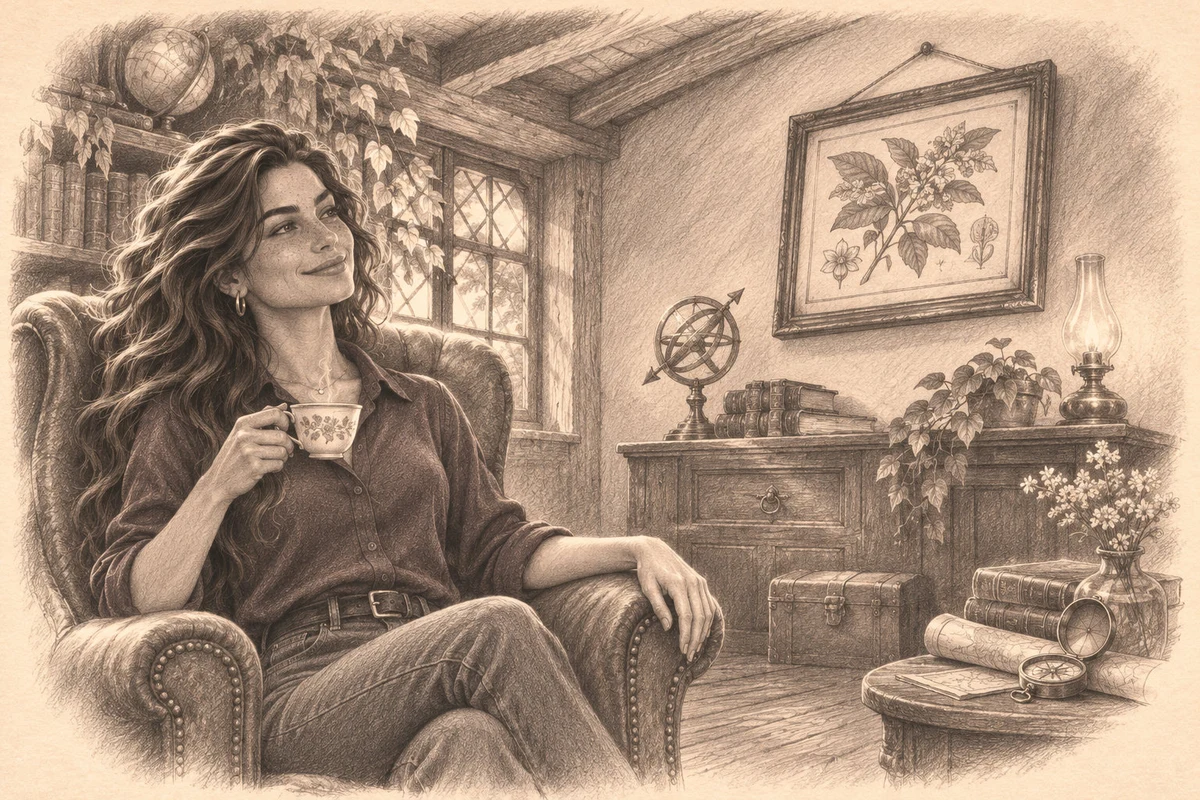
On Sunday, Leyla sat in the armchair with tea.
Sunlight fell through the window. The old house creaked, the floorboards dipped towards the door, and the frame hung where no calculation had originally intended it to be.
A visitor came in, looked at the picture and tilted her head.
"Is that hanging a little crooked?"
Leyla took a sip of tea. "Yes."
"Shall I straighten it?"
"No."
The visitor sat on the sofa. From there, the picture looked different. She tilted her head once more and smiled.
"It does work, though."
"Exactly."
They finished their tea while the evening light slowly moved across the wall. For a few minutes, the window's shadow laid a perfectly straight line beneath the frame. Then the sun moved on and the line vanished. Leyla resisted the desire to note the time. The room was allowed to have one correct moment without turning it into a rule.
Later, the visitor no longer asked about the tilt. She asked only where the beautiful botanical print came from.
That evening, Leyla returned the spirit level to its case. She would need it again. For shelves, models, plans and all the things that deserved a clear line.
But not every wall demanded truth in the centre of a bubble.
Some rooms needed a line that knew their history.
The picture hung quietly.
The house creaked with satisfaction.