Prologue
The Wrong Box
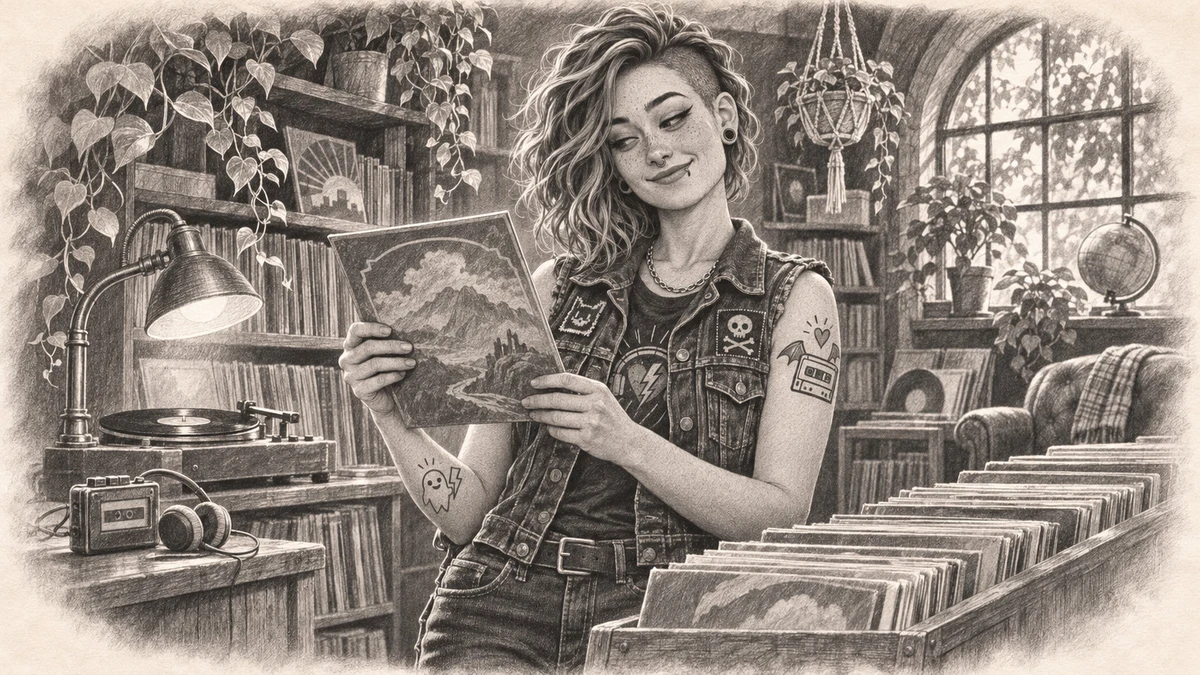
Emma wanted to sort her records.
Not all of them. Just the box beside the shop door, which had carried a handwritten label saying Later for almost a year.
Later had arrived that morning.
Emma opened her record shop, placed her coffee beside the old Walkman and pulled the first album from the box. The cover showed a band in raincoats standing in an empty swimming pool. The music inside was probably either very sad or remarkably loud.
Emma put it on the Punk pile.
The second record contained an eight-minute song about a lighthouse. It went under Post-punk.
The third was by a group that called itself a jazz trio on the front and appeared as fourteen people on the back.
Emma paused.
She tried putting the record under Jazz. Then under Experimental. Then back in the box.
A customer called Paul, who had spent ten minutes pretending not to look for the same record he had searched for the previous week, pointed at it.
"That belongs under punk."
Emma raised one eyebrow. "It is a jazz trio."
"That is exactly what they want you to think."
And with that, the first battle line was drawn.
At seven minutes past ten, three people stood around the box. At twelve minutes past ten, there were five. At twenty past ten, someone had written a sign.
It said: Music cannot be imprisoned.
Emma took a sip of coffee and surveyed the small gathering.
She had not even reached the alphabet yet.
I.
The New Order
The plan had been perfectly sensible. Every record would have a fixed place: first by genre, then alphabetically, and by year of release if there was a tie. Emma had even prepared little divider cards.
Punk. Post-punk. Hardcore. New Wave. Alternative. Things That Could Not Make Up Their Minds.
The last card had been born of experience.
Emma placed the jazz trio record under Things That Could Not Make Up Their Minds. Paul objected. A customer in a red scarf objected to Paul. An older man who had only come in to buy a birthday card declared that music had been simpler in the old days.
"Nothing was simpler in the old days," Emma said. "There were just fewer divider cards."
She pulled out the next record. Its cover showed a single shoe. No band name, no title, no clue of any kind. The back showed the same shoe from a different angle.
Emma put it on the turntable.
First, rain came from the speakers. Then a bass line. Then someone counted very softly to four before slamming a door.
Paul nodded reverently. "Definitely punk."
The woman in the scarf shook her head. "Ambient."
The older man said, "That door needs adjusting."
Emma put the record on the counter. "Undecided."
A second sign appeared beside the first: No classification without a hearing.
No one knew who had written it.
II.
The Factions
By midday, three factions had formed.
The Alphabeticals demanded strict sorting by band name. They argued for findability, common sense and the right to locate a record within three minutes.
The Mood Sorters wanted categories such as Music for Rain, Music for Broken Hearts and Music That Makes You Miss a Bus by Accident. Their proposals were poetic but difficult to fit on labels.
The Unsorted rejected every form of classification. Their spokesman was Paul, although nobody had elected him.
Emma stood behind the counter and listened. As the shop owner, she was legislator, border guard and the only person with access to the kettle. She could have settled the matter.
But Emma loved music precisely because it refused to do what anyone expected of it.
She took a record from the shelf. "What about this one?"
The album began with three fast guitar tracks, continued with a string quartet and ended with a recording of seagulls.
The Alphabeticals said, "Band name under M."
The Mood Sorters said, "Music for complicated Tuesdays."
The Unsorted applauded the seagulls.
Emma returned the record to the shelf. It had always stood under Rock and had never complained.
"We need a break," she said.
Paul raised an empty cardboard sleeve like a placard. "We need change."
III.
The First Stack Falls
Change arrived in the form of a stack of records.
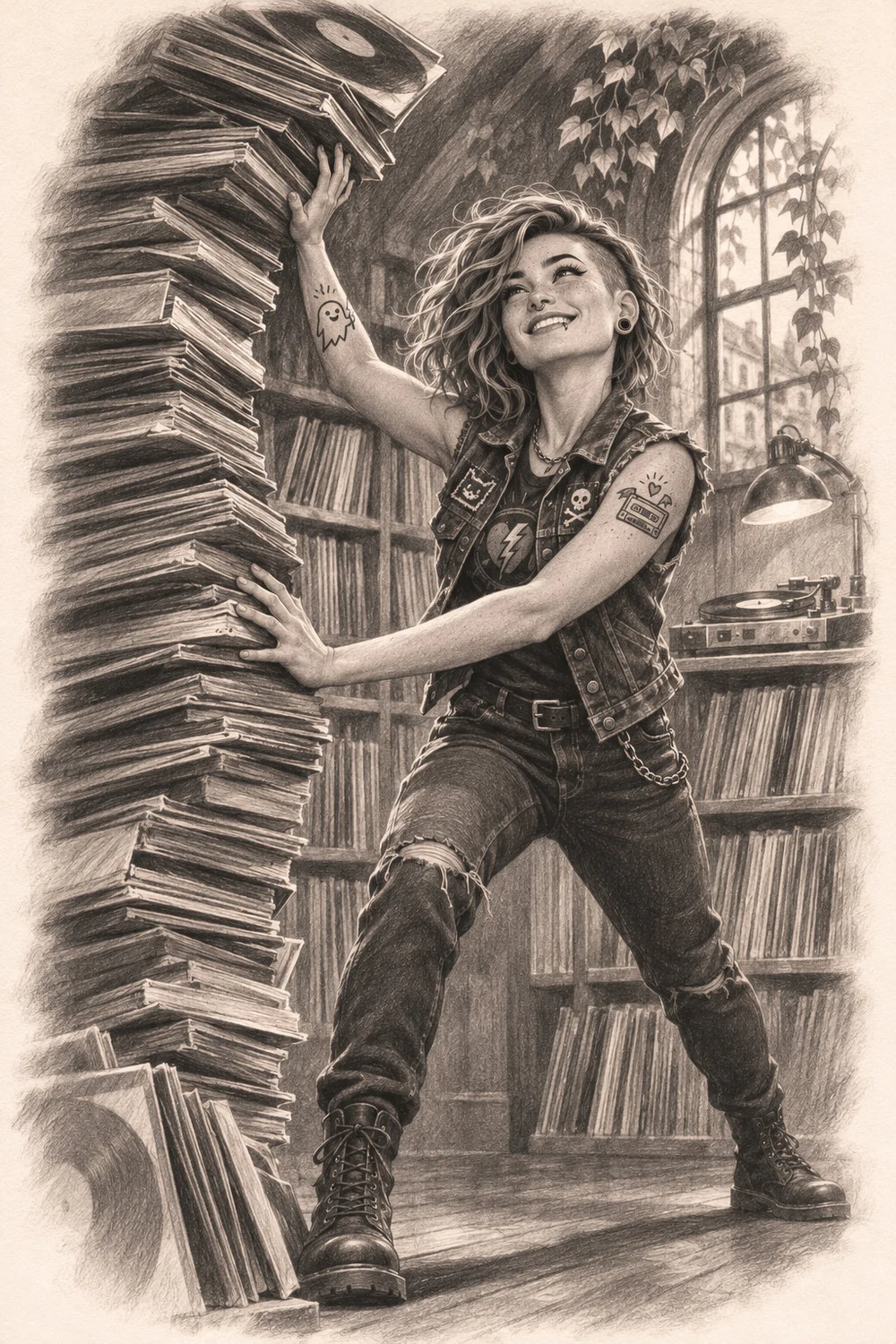
Emma had piled the albums she had already examined beside the box. The stack had grown taller than physics considered polite. When Paul knocked his sign against the counter, it slowly tilted to the left.
Emma saw it move.
She lunged forward, caught the upper half with one hand and supported the lower half with the other. Eighty-three records came to a halt. A single sleeve slipped out, spun through the air and landed flat on the floor.
Nobody breathed.
Emma pushed the stack upright again.
Applause erupted.
"That was not a political act," she said.
Paul lifted his sign. "She saved the archive!"
"I stopped eighty-three records from breaking."
The woman in the red scarf painted a lightning bolt on a new piece of cardboard. The older man stationed himself by the door and told two passers-by that a rescue operation was taking place inside.
Within ten minutes, twelve people had entered the shop.
Emma moved the records into several sturdy boxes. As she did, she discovered that each box was now guarded by somebody determined to defend its musical independence.
The sorting had not merely stalled.
It had acquired an audience.
Emma placed the rescued stack behind the counter for safekeeping. Two people followed it, believing that an exclusive listening session was about to begin there. When Emma sent them back, they retreated by half a step and continued debating whether catching the records might, after all, count as a statement against rigid shelving.
"It was a statement against gravity," Emma said.
Frida wrote the sentence on a piece of cardboard. A little later, it stood in the shop window framed by two hand-drawn lightning bolts. One passer-by photographed it. Another stopped, read it and nodded as though he had just solved a difficult question about life.
Emma began to suspect that every sentence she uttered that day might be dangerous.
IV.
A Record for the Street
Someone opened the shop door to let out the heat. This allowed the music to escape as well.
The shoe record was playing. After the rain came the bass. After the bass came the quiet counting. When the door slammed in the song, a cyclist stopped on the pavement.
"What is that?" he asked.
"Undecided," Emma called back.
The cyclist came inside.
Then a group of teenagers stopped at the window. One of them began tapping her foot to the beat. Paul stood beside the speaker and explained that the record was a manifesto against genre boundaries. Emma wanted to object, but could not prove that it was not.
The woman in the red scarf opened the second window.
Now the bass rolled across the street.
Mira came out of the flower shop opposite and asked whether an event was taking place. Ruby arrived from the bakery with a bag of cinnamon rolls because, in her experience, gatherings lasted longer as soon as somebody started making signs.
Emma turned up the record. Not for revolutionary reasons. The traffic was simply difficult to drown out.
The door in the song slammed again.
Someone outside cheered.
Emma looked at the crowd, then at the box labelled Later.
So far, she had sorted seven records.
V.
Word Spreads
In Goldhain, news travelled by three routes: through the town paper, through the bakery and through people who assured you they had seen it themselves.
At two o'clock, the town paper knew that a discussion about music was taking place in Emma's record shop.
At ten past two, the bakery knew that Emma had invented a new genre of music.
At twenty past two, a man in the market square reported that young people had abolished the alphabet.
The local radio station sent a reporter.
She carried a recorder and looked delighted by the signs. "What is the movement called?"
Emma opened her mouth.
Paul said, "Free Groove."
The Mood Sorters shouted, "Sound Without Cages!"
The Alphabeticals proposed Order with Transitional Regulations.
The reporter waited.
Emma took the microphone. "I am sorting one box."
The reporter nodded solemnly. "And what does this box represent?"
"A box."
On the radio later, this became: Emma rejects simplistic symbols and demands concrete change.
By the time the report was broadcast, forty people were standing outside the shop.
Many of them did not know exactly what they were there for. But the music was good, Ruby was handing out cinnamon rolls, and nobody wanted to be the first to leave a potentially historic moment.
VI.
The Council of Grooves
Emma closed the door, not to shut anyone out but to make it possible to hear the shop for five minutes.
She seated representatives of the three factions at a table. Paul spoke for the Unsorted. The woman in the red scarf, who introduced herself as Frida, spoke for the Mood Sorters. Lena had arrived in the meantime and was immediately appointed to represent the Alphabeticals, although she had only come to collect a record.
Emma placed the troublesome jazz trio album in the middle.
"We will start with this."
Paul explained that every category was a restriction.
Lena explained that the absence of categories restricted people who were looking for something.
Frida explained that a record could be both findable and free if it was sorted by the feeling it produced.
"What if it produces different feelings in two people?" Lena asked.
Frida thought about it. "Then it needs two places."
Emma slid the record safely out of her reach.
The council deliberated for twenty-seven minutes. They agreed that music could possess more than one quality. This was philosophically valuable and practically useless.
Then Emma suggested arranging the records alphabetically and giving each one a small recommendation card describing its mood and style.
All three factions fell silent.
"Too simple," Paul said at last.
"So it will probably work," Lena said.
VII.
The Revolution Begins
Before the council could vote, the power went out.
Only inside the shop. Paul had accidentally hit the switch on the power strip while propping up a sign.
The turntable fell silent in the middle of a bass line. The lights went out. Daylight poured through the open door and fell on Emma behind the counter.
The crowd outside went quiet.
Emma walked over to the sound system, pressed the switch and placed the needle at the beginning of the record.
Rain. Bass. Counting. Door.
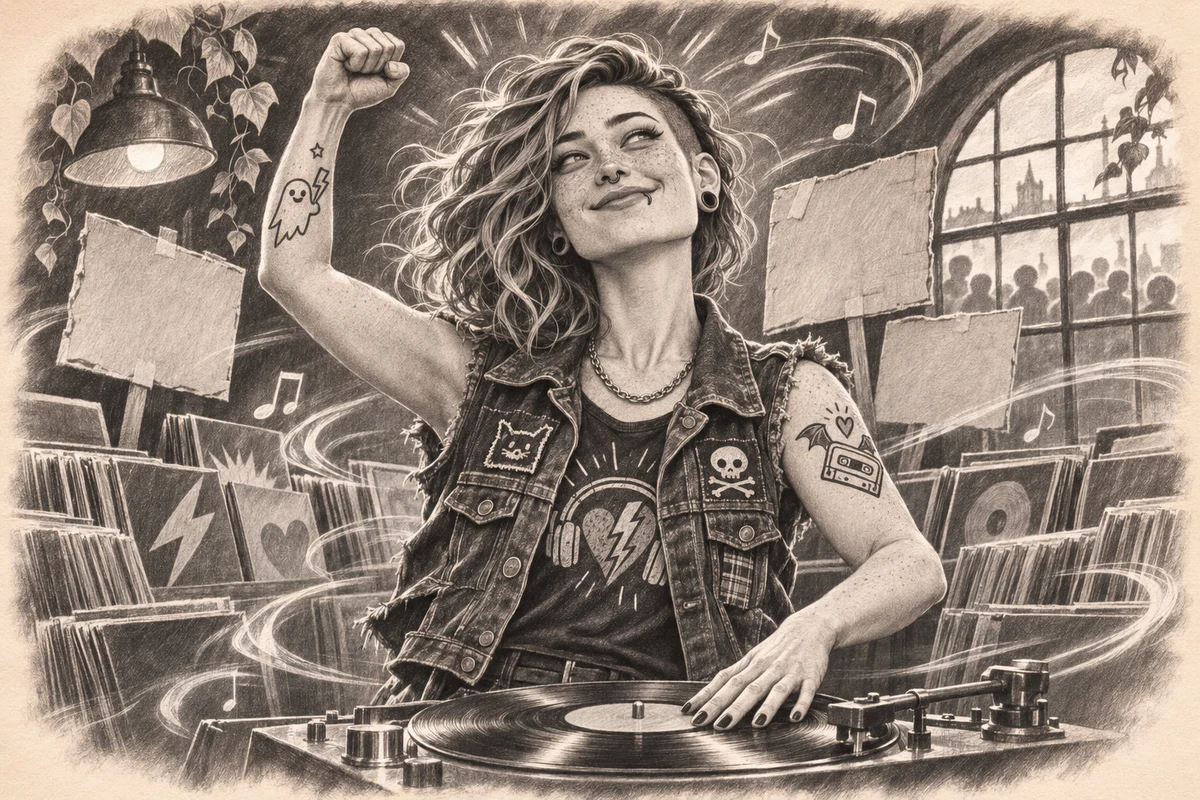
When the music returned, Emma raised one fist. It was not a planned salute. She merely wanted to make it clear to Paul that the power strip was to be left alone from now on.
The crowd raised their fists too.
The reporter shouted into her microphone, "The revolution has begun!"
Emma closed her eyes for a moment.
Then she grinned.
If the town was determined to have a revolution, it might as well sound good.
Emma changed the record. Fast guitars leapt from the speakers. Frida handed out blank pieces of cardboard. The Alphabeticals wrote carefully numbered demands on them. The Unsorted painted lightning bolts over the numbers. Ruby passed cinnamon rolls through the window.
It was the most peaceful uprising in Goldhain's history and the only one in which every participant asked whether shoes were permitted inside before entering.
An improvised cloakroom for rucksacks appeared at the back of the shop so that nobody would scrape a buckle along the record sleeves. Someone handed out water. Mira placed a pot of lavender by the open window because, in her opinion, revolutions did not have to smell of warm coats.
Emma moved from fast punk to a rough live album. Between songs, the audience on the recording could be heard shouting. The crowd outside the shop answered. For a moment, thirty years, two towns and two very different events shared the same beat.
Emma understood why nobody wanted to leave. This had stopped being about divider cards. People had found a place where they could be loud without drowning anyone else out.
VIII.
The Authorities Arrive
At half past four, Mr Kamm from the public order office appeared.
He wore a grey jacket, carried a clipboard and had the expression of a man who used the same form for markets, parades and historical events announced at short notice.
"Who is responsible?" he asked.
Everyone pointed at Emma.
Emma pointed at the Later box.
Mr Kamm looked at her, then at the box. "A public assembly must be registered."
"I opened my shop."
"With amplified music."
"That is not entirely unusual for a record shop."
"With banners."
Emma examined the signs. One now said More B-Sides. Another demanded Rhythm Before Bureaucracy. Lena's had page numbers.
Mr Kamm leafed through his papers. There was a form for demonstrations, one for street music and another for the temporary use of public space. None of them mentioned a misclassified jazz record.
Emma handed him a pair of headphones.
"Listen to the evidence first."
Mr Kamm hesitated, put them on and listened to rain, bass, counting and the slamming door.
His foot moved to the beat once.
He noticed and held it still.
"Undecided category," Emma said.
Mr Kamm selected the form for unusual cultural circumstances.
IX.
The Grand Hearing
The public order office permitted the gathering on condition that the pavement remained clear and nobody used the flower tubs as drums.
Emma placed two speakers in the doorway and declared the hearing open.
Everyone was allowed to name a record they believed had been wrongly classified. The findings were shocking.
A punk album stood under rock. A rock album stood under pop. Nobody would defend one particular pop album in public, although six people secretly bought a copy. A record of whale song was filed under Nature, even though the whales performed with a synthesiser.
Emma heard every complaint. Some were justified. Some were love letters disguised as questions of classification. Some merely proved that people disliked seeing their favourite music share a section with somebody else's favourite music.
She suddenly understood that no one was really protesting against shelves.
They were protesting against the idea that a single label could explain an entire record.
Emma climbed onto a sturdy box.
"We sort alphabetically," she said.
The crowd murmured.
"So you can find what you are looking for. And every record gets a second card: what it is good for, when it helps and which door it opens in your head."
Frida raised her sign. "Complicated Tuesdays too?"
"Especially complicated Tuesdays."
X.
The Work of the Insurgents
A revolution does not end after the speeches. That is when the shelving begins.
Emma handed out boxes, cards and pens. The Alphabeticals sorted band names. The Mood Sorters wrote recommendations. The Unsorted were allowed to listen once to every record whose classification remained disputed.
Paul was given the task of emptying the Later box.
"That is a lot of responsibility," he said.
"That is a lot of later," Emma replied.
The shop became a workshop. Records passed from hand to hand, but never without their sleeves. Lena kept a list. Ruby supplied everyone with pastries. Mr Kamm stayed to supervise the unusual cultural circumstances and eventually wrote a card of his own for an album of quiet piano music: For forms that last longer than the day.
By evening, the shelves had been transformed.
Small cards stood beneath every letter. For rain without sadness. For courage before a difficult phone call. For kitchens at midnight. For days when doors need to slam louder.
The jazz trio record was filed under the group's name. Its recommendation read: For people who stopped counting at three.
Paul agreed.
Nobody mentioned that this amounted to a surrender.
The last difficult record belonged to a band whose name began with a punctuation mark. Lena wanted to file it before A. Paul wanted it after Z, "where the rules grow thinner". Frida proposed putting it in a section called Music for People Afraid of Alphabetical Decisions.
Emma chose a small special section between Z and Still Undecided. The punctuation mark received a place of its own. Mr Kamm noted in the minutes that typographical minorities had also been accommodated.
After that, they cleared the floor together. Anyone who had carried a record checked its sleeve for creases. Anyone who had written a card read it aloud to someone else. The crowd had become a team without anyone handing out membership forms.
XI.
The Last Song
As the sun set, only the participants remained in the shop. The street was clear again. The signs leaned neatly against the wall. Mr Kamm had closed the unusual cultural circumstances case with the note peaceful, clearly audible.
Emma lifted the shoe record from the turntable.
Inside the sleeve, she found a small piece of paper that nobody had noticed before. The band name and title were written on it in tiny handwriting. The record was not anonymous. It was merely badly labelled.
Lena found the name in the new alphabet. "Under S."
Frida wrote the recommendation: For the moment when a small task suddenly becomes history.
Paul added a lightning bolt.
Emma slid the record into place.
The Later box was empty.
Everyone waited for a speech. Emma was not particularly interested in speeches. Instead, she put on one final record, a fast, warm recording with scratchy vocals and a chorus nobody fully understood.
She turned up the volume.
Paul danced between the boxes. Frida raised a sign. Lena moved her foot so little that she could later deny any involvement. Even Mr Kamm remained in the doorway until the song was over.
Then they applauded.
Not for the order.
For everything it had made room for.
XII.
The New Section
The next morning, Emma opened the shop an hour late.
Customers were already waiting outside. Some wanted to hear the famous record. Others had brought albums that, in their opinion, deserved mood cards of their own.
Emma let them in.
The new system worked remarkably well. People found records more quickly and stayed longer because they read the little cards. Someone bought an album solely because of the recommendation For bus journeys on which you travel too far. Blitzy took it and said she felt seen.
Emma fixed a new divider card above an empty shelf: Still Undecided.
It was smaller than the old box and deliberately not alphabetical. Records that still required discussion stood there. Not as mistakes, but as invitations.
Paul examined the section. "A protected habitat."
"A shelf," Emma said.
"A free shelf."
Emma let him keep the word.
That afternoon, the radio reporter returned and asked whether any further actions were planned.
Emma pointed at a stack of unsorted cassettes behind the counter.
The reporter took a step back.
"Not yet," Emma said.
Finale
Side B
The following week, the town paper reported on the Goldhain Punk Rock Revolution. It printed a photograph of Emma with her fist raised in front of blank signs. The caption said she had renegotiated the relationship between order and freedom.
Emma did not frame the article.
She used it to steady a wobbly box.
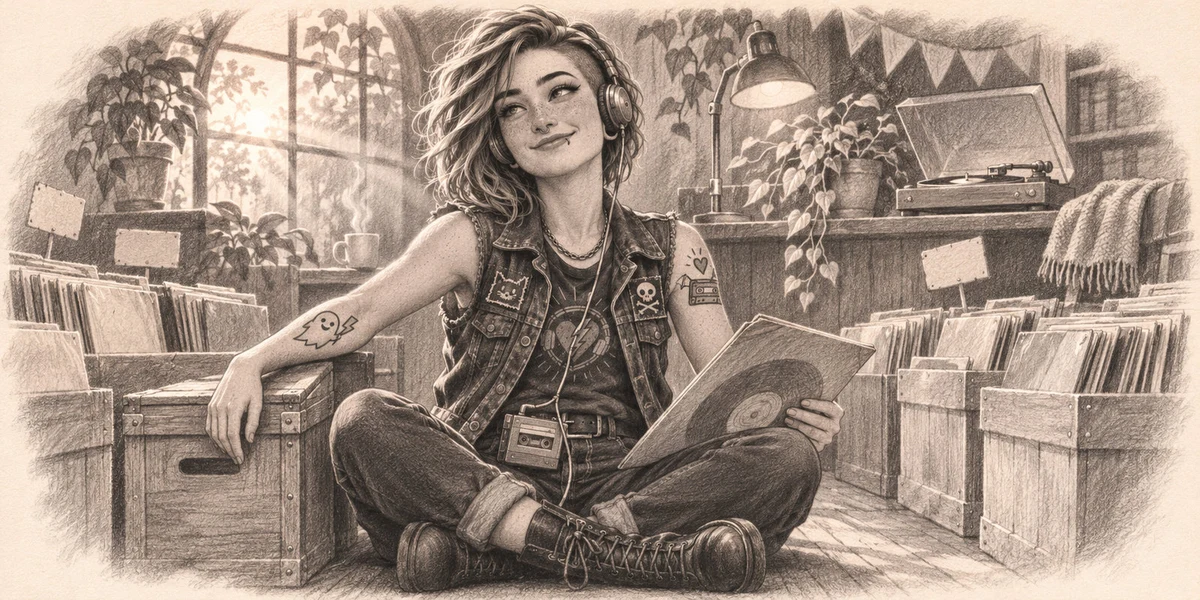
The record shop was quiet again. Plants hung in the morning light, the turntable revolved and Emma sat among the boxes with her old Walkman. The shelves were orderly without seeming strict. Every record had a place. None was confined to it.
Frida's cardboard lightning bolt lay on one box. Paul's sign stood beside it, its back now covered with a list of unfinished jobs. Emma had kept both, not because she wanted to lead a movement but because good days were allowed to leave traces.
Two teenagers stopped outside the window and read the mood cards. One pointed at a recommendation. The other laughed, and then they both came inside. Emma watched them from the corner of her eye and let the shop explain its new order for itself.
Emma put on her headphones and listened to the shoe record.
Rain. Bass. Counting.
Just before the door slammed in the song, the shop door opened for real.
Nika came in carrying a box of old CDs.
"Can you sort these too?"
Emma removed the headphones.
She looked at the empty Later box, the signs against the wall and the article beneath the unsteady shelf.
Then she grinned.
"Of course," she said. "Five minutes."
Across the street, Mr Kamm began searching for the unusual cultural circumstances form, just in case.