Prologue
Six People
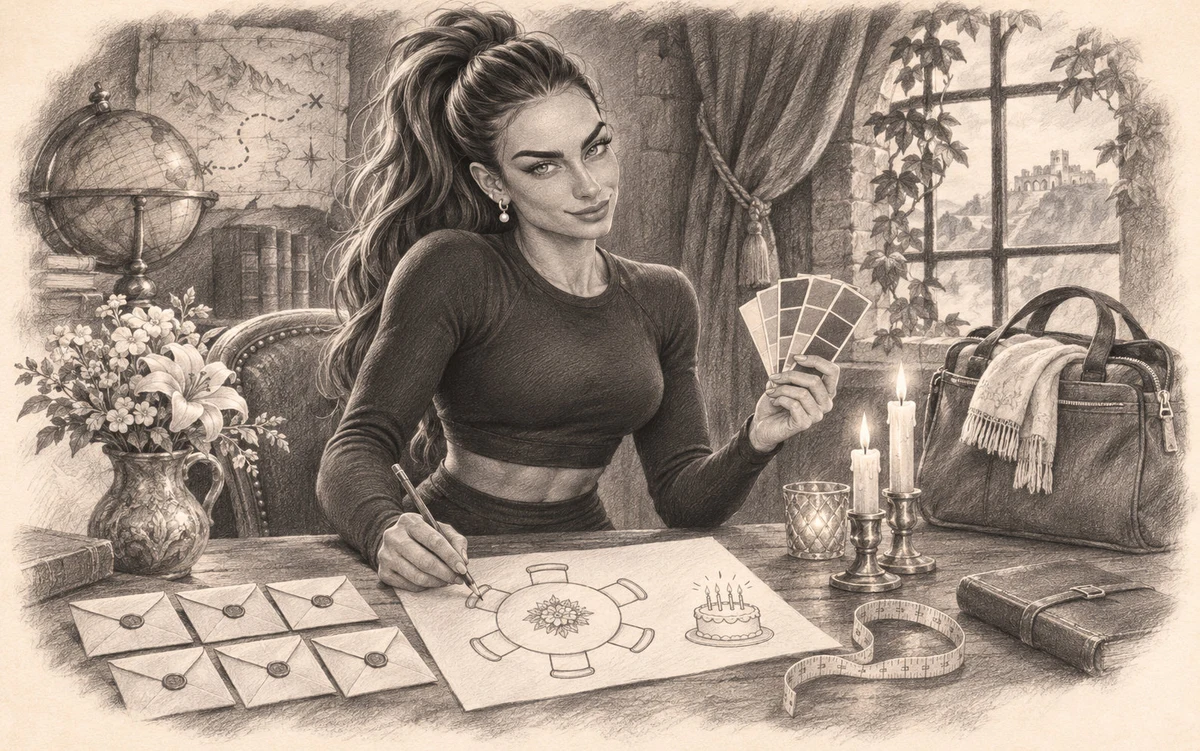
Sofie wanted to organise a small birthday party.
Six people. One round table. One cake. A few flowers. No stage, no fireworks and expressly no delegations.
The birthday belonged to Mira, who liked large events so long as she did not have to attend them. Sofie had therefore promised that the evening would remain quiet.
She designed six invitations, chose cream-coloured napkins and reserved the small conservatory at Goldhain's Assembly House. In the box marked Number of participants, she wrote a very clear 6.
Under Occasion, she wrote: private birthday.
Under Special requests, she wrote: small, warm, uncomplicated.
Then she submitted the form.
The Assembly House called the following morning.
"Your event has been moved to the Grand Ballroom."
Sofie held her little espresso cup in mid-air. "Why?"
"The conservatory is not licensed for six international groups."
"Six people."
Paper rustled at the other end.
"It says 6 P here."
"P for people."
"Our software reads P as partner nations."
Sofie briefly closed her eyes.
"Then change it."
"The Grand Ballroom has already been confirmed. The flags arrive at ten."
Sofie looked at her six invitations.
She had had a plan.
Now she had room for eight hundred people and presumably a flag for every continent.
I.
The Grand Ballroom
The ballroom was larger than some railway stations.
Sofie stood beneath three chandeliers and surveyed the area intended for one table and six chairs. Her footsteps echoed. At the far end of the room, a small weather system could have gone unnoticed.
Mr Balduin, the caretaker, showed her the booking. Six partner groups. International reception. Private anniversary.
"Birthday," Sofie said.
"The system turned it into an anniversary."
"Of what?"
"Undetermined."
Sofie placed her organiser bag on the floor. A sensible person would have cancelled everything. Sofie was an event designer. She did not regard an empty hall as a problem, but as an unreasonable amount of unused possibility.
"We'll put the table in the middle," she decided.
Mr Balduin looked across the ballroom. "It will seem very small."
"Then we'll make the middle smaller."
She planned a circle of flowers, warm lamps and light curtains. The rest of the ballroom would remain dark. A hall was going to become a room.
The new plan was elegant.
At a quarter to ten, a lorry carrying eighty chairs pulled up outside the entrance.
II.
The First Delivery
The driver had a delivery note for six groups plus guests.
Sofie showed him the six invitations.
He showed her eighty chairs.
"The order has been paid for," he said.
"By whom?"
"The Fund for International Exchange."
The fund had discovered the automatically generated event and approved a grant before anyone could explain that Mira was merely having a birthday.
Sofie called them. A friendly voice congratulated her on being selected as Encounter Format of the Month. The chairs could not be returned. Returns were only possible after the event.
Sofie looked at the driver. "Set up sixteen. We'll stack the others against the wall."
Six chairs became sixteen, because symmetry required a certain minimum quantity in a ballroom of that size. Sofie removed one row later, then added two armchairs. Eventually the little table stood inside a cosy semicircle.
"You have nine seats now," Mr Balduin observed.
"Three are atmospheric."
The driver unloaded the remaining chairs.
As Sofie covered the last stack with fabric, a second lorry arrived.
It carried flowers for a state reception.
First, however, every chair had to be inspected. Some wobbled, some had cushions of different heights, and one bore a small brass plaque underneath stating that it was reserved exclusively for formal addresses. Sofie sorted them by height and had Mr Balduin place felt beneath the restless legs.
She used the six finest to form the true circle. The rest became walls: the stacks vanished behind lengths of fabric, plants and lamps until they resembled architectural columns. The driver examined the result and asked whether she always planned this way.
"No," Sofie said. "Normally the problems happen in a sensible order."
III.
The Botanical Incident
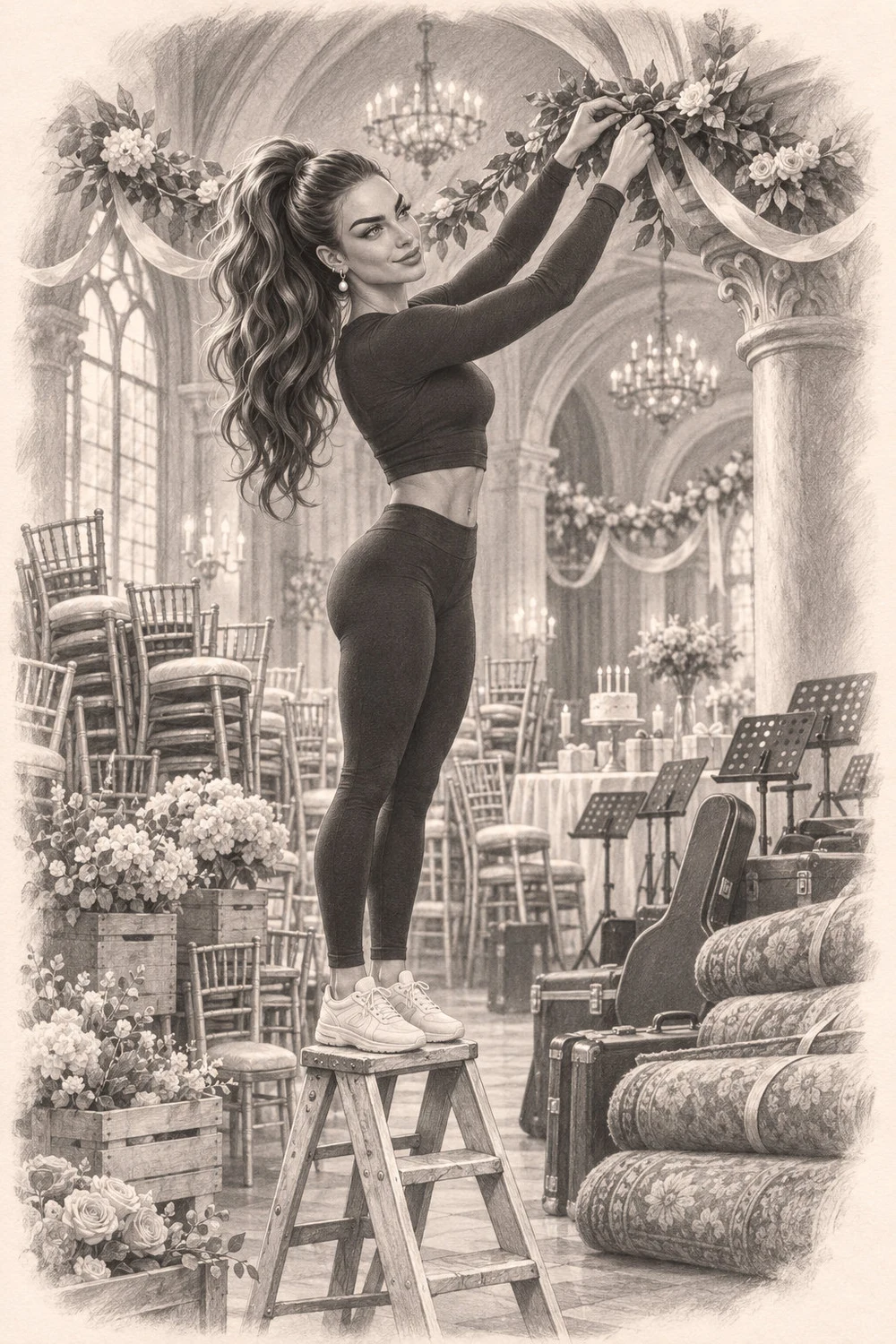
There were enough flowers for a royal wedding.
Roses, lilies, hydrangeas and branches filled crates, vases and two trees on wheels. The delivery note listed six table arrangements. Each arrangement had apparently been calculated for a table of forty.
Sofie thought of Mira's request: a few flowers.
"These are a few," the florist said. "Several fews."
Sofie could have refused the delivery. Then she looked at the arches of the ballroom and developed a third plan.
She did not build a state reception. She built a garden.
Flowers framed the little island of tables. The wheeled trees concealed the stacked chairs. A narrow floral arch marked the entrance. Sofie stood on a ladder and fastened branches beneath the chandeliers.
The ballroom grew warmer. Not smaller, but friendlier.
Mira wrote: Everything quiet?
Sofie photographed only the cake design and replied: Perfectly.
At that moment, Mr Balduin rolled a red carpet through the door.
"It's part of the international booking."
"We don't need a red carpet."
"It is ninety metres long."
Sofie considered the entrance hall, the broad staircase and the street outside.
Her fourth plan began without permission.
IV.
The Red Route
The carpet did not fit inside the ballroom. Nor did it fit completely inside the Assembly House.
So Sofie ran it from the little birthday table through the hall, down the stairs, across the foyer and out through the entrance. Eighteen metres still remained.
Mr Kamm from the Public Order Office appeared, because red carpets on public pavements constituted temporary use. He brought velvet ropes.
"Only six guests," Sofie said.
Mr Kamm looked at the carpet. "They won't get lost."
The ropes made the entrance official. Passers-by stopped. An elderly woman asked who was expected. Sofie said, "Mira."
The woman nodded, impressed, although she did not know Mira.
Within the hour, three photographers were stationed beside the carpet. They had heard that an international figure was celebrating in Goldhain. Sofie explained that Mira photographed butterflies and was unquestionably a person of distinction, though not in the expected sense.
The photographers stayed. They had already set up their cameras.
Sofie provided tea and asked them not to frighten Mira.
With small strips of tape, she marked precisely where the photographers were allowed to stand. No camera was to point directly at the birthday table. No flash was permitted to reach the replacement conservatory. Anyone who wanted a picture could have the floral arch, the carpet and, later, perhaps Mira's consent.
The photographers accepted the rules with surprising enthusiasm. Clean lines were familiar territory. One even helped weigh down the end of the carpet so it would not curl up again. Another photographed only the empty staircase and declared that it already conveyed everything about the importance being anticipated.
Sofie decided not to ask what importance he meant.
Then the first orchestra arrived.
V.
The First Orchestra
It was a chamber orchestra with twelve members.
The conductor showed Sofie a confirmation for musical accompaniment during the reception. The international fund had booked the ensemble.
"We only need quiet background music," Sofie said.
"We can do quiet."
The orchestra took its place behind the flowers and played a delicate piece that truly sounded wonderful. Sofie relaxed. Twelve musicians were more than six guests, but they fitted inside the hall without filling it.
Mira would see the garden, hear the music and perhaps never discover that everything had accidentally become international.
Then the second orchestra appeared.
It consisted of twenty-five brass players and one large drum.
Its director explained that they had been booked for the ceremonial entrance. Sofie pointed to the chamber orchestra. The two conductors compared their paperwork. Both bookings were valid.
Sofie divided the duties. The brass would play outside, very briefly and only as the guests arrived. The chamber orchestra would remain indoors.
"And the drum?" Mr Balduin asked.
Sofie pointed to the farthest corner of the garden.
The drummer understood. Good musicians recognised sensitive birthdays.
At one o'clock, the third orchestra appeared.
It had the same booking number as the others, but a different time and an additional note: a musical bridge between cultures. Sofie regarded the instrument cases. There were enough bridges to cross the entire ballroom.
She asked the three conductors to demonstrate their volume one at a time. The chamber orchestra played like rain against a window. Even at its quietest, the brass sounded like a royal arrival. The salon orchestra could be elegant and unobtrusive at the same time, which Sofie immediately recognised as a core skill.
Afterwards, she assigned times, routes and rehearsal rooms. Three competing bookings became a programme.
VI.
Three Orchestras, Six Plates
The third ensemble was a salon orchestra in white jackets. It was meant to play during dinner.
Sofie stood between three conductors, six guest plates and eighty chairs.
"We could take turns," suggested the chamber orchestra's conductor.
"Or play together," said the brass director.
The salon bandleader smiled. "Which piece?"
They tried a simple birthday tune. The strings began softly, the brass entered with the second phrase, and the salon orchestra placed a dancing rhythm underneath. The large drum played just one beat at the end.
The chandelier trembled.
Sofie raised one finger. "Half a drum."
The next attempt was perfect: grand, warm and surprisingly personal.
Sofie wrote a running order. Orchestra one welcomed the guests inside the ballroom. Orchestra two played four bars outside for each arrival. Orchestra three accompanied the cake. They would play together only once.
"For six people?" Mr Balduin asked.
"Then everyone gets ten musicians personally."
He accepted the arithmetic.
Cameras were now flashing behind the front door. Three photographers had become twelve.
Sofie arranged water, fruit and a separate resting area for each orchestra. You could not give musicians who had to wait six hours one plate of biscuits and expect international harmony. Ruby arrived with baskets from the bakery and took charge of provisions.
"How many guests?" she asked.
"Six."
Ruby looked past three orchestras. "Of course."
She put down the baskets without asking for any further explanation. Sometimes friendship meant accepting the scale of a thing before understanding its cause.
VII.
The International Press
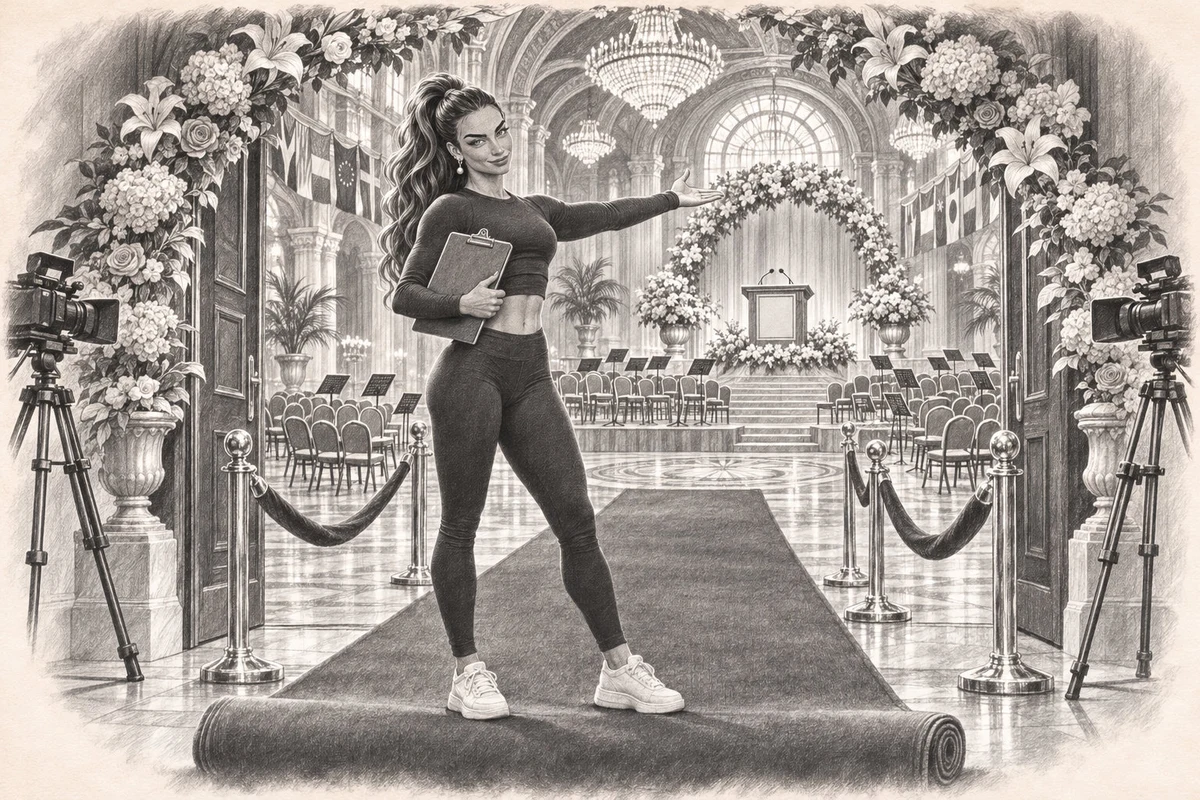
The story had reached the regional news service.
A misread line described the celebration as a private anniversary with six partner nations. No one knew which anniversary was meant. That was precisely why it seemed important.
Reporters came from neighbouring towns. Two wore headsets for simultaneous translation. One correspondent asked whether there would be a closing statement.
"There will be cake," Sofie said.
The correspondent wrote something down.
Sofie established a press area in the next room. Not because she intended to hold a press conference, but to keep the cameras away from the birthday table. A podium happened to be in storage. Mr Balduin set it up. The flags of the supposed partner nations were already hanging behind it.
Sofie drafted three rules:
No questions for Mira without permission.
No cameras during dinner.
No diplomatic interpretation of the cake.
The third rule became necessary because the pastry chef had delivered a cake with six sugar flowers. One reporter took them for symbols of the six partner nations.
"They're roses," Sofie said.
"Six roses," the reporter said.
Sofie covered the cake.
Some meanings needed temporary protection from the public.
Sofie gave the press a precise schedule: six minutes for pictures of the ballroom, five minutes for questions to the organiser and zero minutes for spontaneous broadcasts from the birthday table. The reporters negotiated. Sofie remained friendly and immovable.
When a camera nevertheless rolled towards the little table, she placed her organiser bag in front of it. The bag was wine-red, elegant and remarkably effective as border control.
The correspondent with the headset asked whether Sofie designed international summits professionally.
"Birthdays," Sofie replied.
"Are they very different?"
Sofie looked at the flags. "Not different enough today."
VIII.
The Guests of Honour
At three o'clock, the Town Hall announced that several cultural representatives were on their way.
They had seen the press reports and wished to use the opportunity for an exchange. Sofie explained once more that this was a birthday. The Town Hall replied that birthdays were excellent occasions for cultural exchange.
Six vehicles pulled up.
One person bearing a small gift emerged from each. None of the delegations had brought an entourage. They were friendly, slightly confused and visibly relieved that no political speeches were scheduled.
Sofie seated them on the three atmospheric chairs and six more from the stack. The table area now contained fifteen seats.
"Mira wanted six people," Mr Balduin said quietly.
"Mira will get six people."
Sofie established a second table in the garden for the cultural representatives. The orchestras played there in shifts. The press remained in the next room. Flowers and curtains screened off the real birthday table.
In the middle of the large event, a small protected island took shape.
Sofie considered it.
The fifth plan was the first one that resembled the original again.
Then Mira wrote: I'll be there in ten minutes.
IX.
Mira's Arrival
Sofie went to the entrance.
The red carpet lay unfurled. Twelve cameras waited behind the rope. The brass orchestra raised its instruments. Mr Kamm kept the pavement clear. Three cultural representatives happened to be standing in the foyer.
Mira arrived by bicycle.
She braked in front of the carpet and looked towards the Assembly House. "Is something else happening here?"
Sofie smiled. "Technically, no."
Mira saw the cameras. "Sofie."
"Everything is under control."
The brass played four bars. Very quietly. The drum remained entirely silent.
Mira wheeled her bicycle along the red carpet. The photographers obeyed Sofie's rules and photographed her only from behind. One took the bicycle for a symbol of down-to-earth diplomacy.
The five invited friends were waiting in the foyer. They hugged Mira, gathered around her and led her through the floral arch.
When Mira saw the little table, she stopped.
Six places. One cake. Warm lights. A few flowers - if one did not count the garden behind them.
"You kept it small," she said.
Through a gap in the curtain, Sofie looked at three orchestras, six cultural representatives and an international press zone.
"I kept the small part small."
Mira laughed.
That completed the most important item on the programme.
Sofie did not lead Mira directly to the table. First they remained beneath the floral arch, where the noise of the foyer softened behind them. In three sentences, Sofie explained what had happened: letter, cultural fund, escalation. Mira listened, looked at the carpet once more and began to laugh.
Not politely. Not carefully. So hard that she had to hold on to her bicycle.
"You turned a typo into a state reception."
"I rescued a birthday from a state reception."
Mira wiped her eyes. "That sounds more like you."
Only then did they go inside.
X.
The Celebration at the Centre
The six friends took their seats. The curtain softened the music. The cameras remained outside. Exactly six plates and six glasses stood on the table.
Mira opened her presents. They were small things: a photo book, a scarf, a plant, a handwritten letter, a case for lens caps. None of them possessed international importance.
Sofie served truffle tagliatelle from a small kitchen behind the ballroom. Then she brought out the cake.
The salon orchestra played quietly. The chamber orchestra joined after eight bars. Outside, the brass remained silent until the candles were lit.
Mira closed her eyes and made a wish.
Through the curtain, Sofie signalled to the large drum.
One single gentle beat sounded as Mira blew out the candles.
The ballroom applauded. Not only the little table. The musicians, cultural representatives, reporters and Mr Kamm all clapped behind the curtains.
Mira opened her eyes. "How many people are here?"
Sofie began to cut the cake. "Would you like the honest answer or the designer's answer?"
"The designer's."
"Six. With a great deal of atmosphere."
XI.
The Press Conference
After dinner, Mira asked whether she might see the event that was supposedly not taking place.
Sofie opened the curtain.
The Grand Ballroom glowed. Orchestras sat among flowers. Cultural representatives were talking in the garden. Cameras waited in the next room. The red carpet led all the way to the little table.
Mira studied it all with the calm attention of a photographer who had discovered a rare butterfly.
"All this happened because of my cake?"
"Because of one letter."
The press requested a brief statement. Mira agreed, provided Sofie stood beside her.
They stepped up to the podium. Camera flashes flared.
One reporter asked what the six roses symbolised.
Mira replied, "Six slices of cake, if Sofie cuts fairly."
Another asked about the message of the bicycle.
"That I don't like looking for parking."
The cultural representatives laughed. The press took notes.
Sofie explained the booking error. No one was disappointed. On the contrary: the truth was better than the diplomacy they had imagined.
The press conference lasted seven minutes. Its closing statement was: birthdays are allowed to be small, even when the ballroom becomes large.
XII.
Taking It Down
Late that evening, the guests left. The cultural representatives took cake with them. Reporters coiled their cables. Three orchestras played one final quiet piece together.
Then it became still.
Sofie sat beside the little table, one hand resting on her closed organiser bag. The red carpet was rolled up, chairs were stacked and cameras were covered.
Mira stayed behind.
"Was it awful?" she asked.
Sofie took an espresso. "It was different."
"You made five plans."
"Six."
"Which was the best?"
Sofie looked at the round table with six places. "The first. I merely had to find it underneath the others."
Mira took a photograph of her: Sofie with the cup, the small remainder of cake and the vast empty ballroom in the background.
Later, it became the only picture of the evening that Sofie framed.
Not the red carpet. Not the orchestras. Not the podium.
The little table in the large room.
Before they left, Sofie counted the six plates. Exactly one piece of cake was missing from each. The candles had burned down, the glasses were empty and the napkins were crumpled. They were the unassuming traces of a real birthday, entirely independent of the size of the hall.
Mr Balduin wanted to know which cost centre should cover the remaining flowers. Sofie wrote on the receipt: Misunderstanding with a happy ending.
He considered the words. "That isn't a cost centre."
"Then it ought to be."
Mr Balduin put the receipt in his pocket. Many useful categories came into existence that way at the Assembly House.
Finale
Seven People
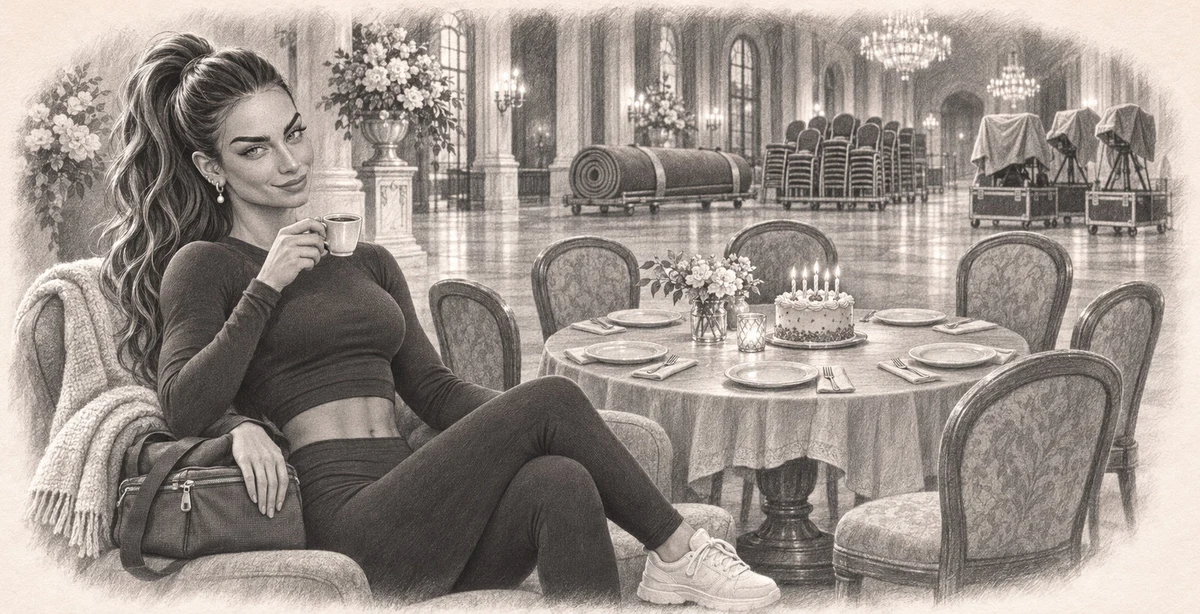
One week later, Sofie received a letter from the Fund for International Exchange.
The birthday party had been honoured as an exemplary international encounter format. The fund wished to repeat the concept the following year.
Planned attendance: six hundred.
Sofie took a red pen and crossed out two zeros.
Beside them, she wrote: six people.
She photographed the correction and sent it to Mira.
Mira replied: Conservatory this time?
Sofie wrote: Living room this time.
At the next birthday, six chairs stood in Mira's flat. The cake was small, the flowers fitted in one vase, and no orchestra waited in the corridor.
Sofie counted the guests.
One, two, three, four, five, six.
Then the doorbell rang.
Mr Balduin was standing outside with a folded red carpet.
"It was still in storage under your name."
Sofie looked into the living room. Then at the carpet. Then she smiled slowly.
"Only as far as the kitchen table," she said.
Mira called from the room, "Sofie."
"Very small," Sofie promised.
The carpet unrolled along the corridor.
There were seven people.
But only six chairs.