Prologue
Two Bread Rolls
In Goldhain, there were distances measured in metres and distances for which Blitzy said, "That's just down the road." Between those two categories there usually lay several villages, one misunderstanding and at least one object she had not owned when the journey began.
On that Saturday morning, however, the problem lay so peacefully on the kitchen table that even a cautious person would have seen no cause for concern. It was a note. It said: two bread rolls, some butter if it was on offer, and please do not come back with another camping stove.
Blitzy read the list, drank the last of her coffee and looked out of the window. The bakery stood at the end of the street. Its striped awning was visible from the front door. A sensible four-minute walk. Perhaps two by bicycle.
"I'll take the bike," Blitzy said to no one in particular.
She pushed her sunglasses into her ash-blonde bun, checked that her ring pendant was in place and wheeled the bicycle out of the courtyard. Its basket contained a cloth bag, a folded rain poncho and a spanner whose presence she could not explain but found reassuring.
The butter dish remained behind on the breakfast table. It was still closed.
Ten minutes later, Blitzy was no longer in Goldhain.
I.
The Diversion
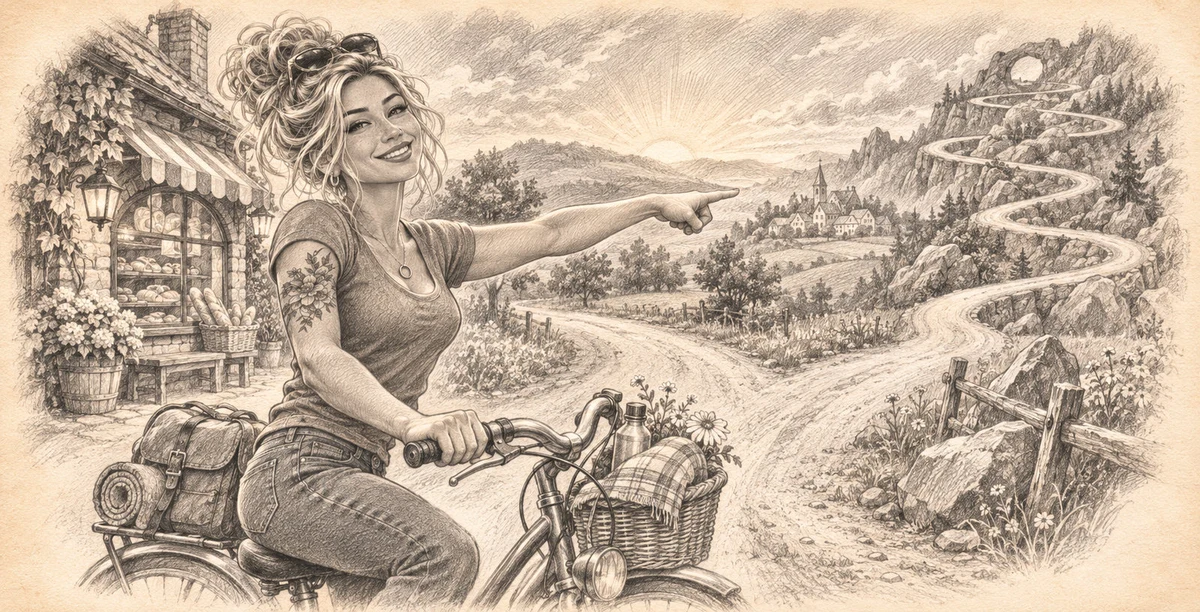
A red-and-white barrier stood outside the bakery. Behind it, a man in work clothes knelt beside a hole in the pavement roughly the size of a soup plate.
"Water main," he explained as Blitzy braked.
"Do I have to go around?"
The man pointed to a yellow sign. One arrow indicated left. Someone had chalked a second arrow underneath it, pointing right. A third arrow, sawn from a piece of wood and attached to a lamppost with remarkable confidence, pointed straight through a rose arch.
"The official diversion is to the left," said the workman.
Blitzy considered the three possibilities. To the left, a narrow road ran between houses. To the right lay the market square. Straight ahead was a path she had never taken. It passed between two gardens and disappeared behind a row of old chestnut trees.
"What about that one?"
The workman looked at the wooden arrow as though he were seeing it for the first time. "That isn't ours."
This was not a warning. In Blitzy's understanding, at least, it was a recommendation with an air of mystery.
She rang her bell once, rode through the rose arch and called over her shoulder, "I'll be right back!"
The path was pleasant. Birds sang, sunlight filtered through the leaves, and beyond every bend the bakery appeared to be only one more bend away. Then the road began to slope downhill. Gently at first, then with conviction. Blitzy stopped pedalling. The wind tugged at her loose strands of hair, and the bicycle developed the lively initiative machines tend to display the moment they suspect the human has surrendered command.
"All right," said Blitzy, leaning over the handlebars. "Fast it is."
II.
The Hill Without End
The hill turned out to be a mountain range in a polite disguise.
Blitzy shot past allotment gardens, a field of deeply surprised sheep and a signpost with Goldhain written on the arm behind her. Ahead lay places whose names she knew only from weather forecasts. The brakes worked. That was comforting. She did not use them immediately, because the road was clear and the morning so bright that caution felt like an unnecessary interruption.
After five minutes, the tarmac became cobbles. Five minutes later, the cobbles became a country road. When she finally applied the brakes, the air smelt of salt.
Blitzy planted one foot on the ground and looked over a low wall. Below her lay a harbour. Boats rocked between the quays. Gulls circled over fish stalls. A sign bore the name of a coastal town that was almost two hours from Goldhain by train.
She took out the shopping list. Two bread rolls. Butter, if on offer. No camping stove.
The wind had torn one edge, but otherwise the list seemed remarkably untroubled by events.
"Fine," said Blitzy. "I'll buy the rolls here."
The first bakery by the harbour was closed. The second sold only fish pies. At the third, a woman behind the counter explained that the rolls had sold out because of a harbour festival. She recommended a bakery on the far side of the water.
"Is it far?" Blitzy asked.
The woman pointed to a ferry that was lowering its ramp. "Just down the road."
Blitzy smiled. At last, someone who described distances sensibly.
III.
The Official Breakfast Document
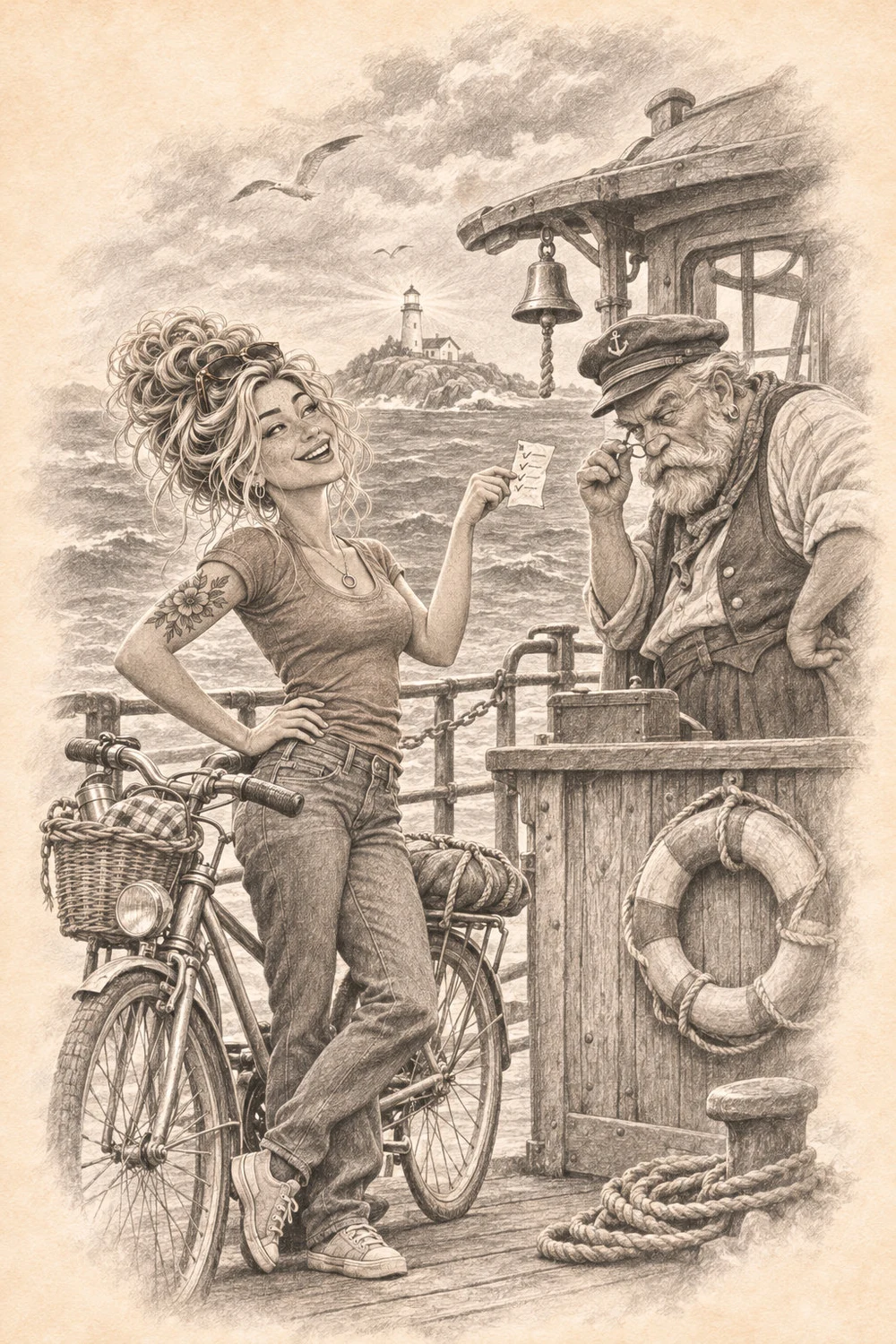
A ferryman with a grey beard stood before the ferry. A tiny anchor was pinned to his cap, and he inspected tickets with the solemnity of a man who had personally been entrusted with the ocean.
"Ticket," he said.
Blitzy patted her pockets. She found two coins, a cable tie, a button and the shopping list.
"I'm only going to the bakery."
The ferryman took the note. He read it from top to bottom, turned it over and studied the blank reverse. "Butter only if it's on offer?"
"I have clear instructions."
"So I see."
He drew a heavy stamp from his jacket and pressed it onto one corner of the paper. The mark showed a wave, a lighthouse and a date. Then he handed the document back.
"Deck two. Secure the bicycle."
Blitzy was going to ask whether this truly counted as a ticket. But a family with three suitcases was already waiting behind her, and the ferryman had turned to the next passenger.
On deck, Blitzy rested the bicycle against the rail. The harbour slid away. The roofs grew small, the gulls grew loud and the water grew unexpectedly large. She held the stamped shopping list up to the light.
"It doesn't look very international," she murmured.
A sailor beside her laughed. "The ferry is taking the grand circuit today."
"How grand?"
He pointed towards the horizon. There was nothing there but sea.
"With a stop on the way."
At that moment, the coast disappeared behind them in the haze.
IV.
The Grand Circuit
The ferry was smaller than a cruise ship and larger than any decision Blitzy had intended to make that morning. It carried lorries, bicycles, a coach full of hikers and two sailors who noticed at once that Blitzy was incapable of sitting still.
She walked around the deck, helped an elderly woman free a jammed suitcase handle and used her spanner to repair a loose bell on the ship's bicycle. Then she returned to the rail.
The sea was grey-blue and endless. The wind smelt of salt and engine oil. Blitzy thought of the breakfast table. By now, someone had probably eaten the butter without any bread. Perhaps someone had gone to the supermarket. That would be practical, but narratively weak.
"You don't look seasick," said one of the sailors.
"I'm only breadless."
He nodded as though this were a recognised maritime emergency. Then he pointed to a narrow passage running around the upper deck. "One circuit by bicycle takes two minutes in calm seas."
Blitzy looked at him. He looked back. The second sailor produced a stopwatch.
It did not become an official event. There was no starting line, no rulebook and no authorisation. Even so, before long twelve passengers were clapping in rhythm while Blitzy raced across the deck, swept around a bench and dodged a gull that had misunderstood its duties as a course marshal.
She narrowly defeated the sailor, who did not own a bicycle and therefore pushed a luggage trolley.
"New shipboard record," the ferryman announced later without smiling.
He added a second stamp to the shopping list.
V.
The Far Shore
The stop lay on a coast that not only looked different, but sounded different. Bells rang in a language Blitzy did not understand. Traders called prices across the quay, and flags in colours she had not expected that morning fluttered above the roofs.
"Which country is this?" she asked the ferryman.
He gave her a name.
Blitzy needed a moment. Then she held up the stamped shopping list. "Can I enter with this?"
The ferryman considered his two stamps. "For two bread rolls, it will do."
The ramp lowered. Blitzy wheeled the bicycle ashore. Behind her, the ferry departed almost immediately, for it would not return until evening.
The market began directly at the harbour. Lengths of fabric hung between the houses, spices lay in open sacks, and copper jugs flashed in the sunlight. The air smelt of coffee, roasted nuts and warm bread.
Blitzy followed the scent.
She asked a fruit seller for a bakery. He explained the route using both arms and three fountains. A carpet seller contradicted him and added a tower. An old man outside a spice stall traced a spiral in the air with one finger. A donkey watched and appeared to be the only one who knew the route but preferred not to interfere.
Ten minutes later, Blitzy stood where she had begun.
"Perfect," she said. "At least now I know where I am."
VI.
The Market of Seven Directions
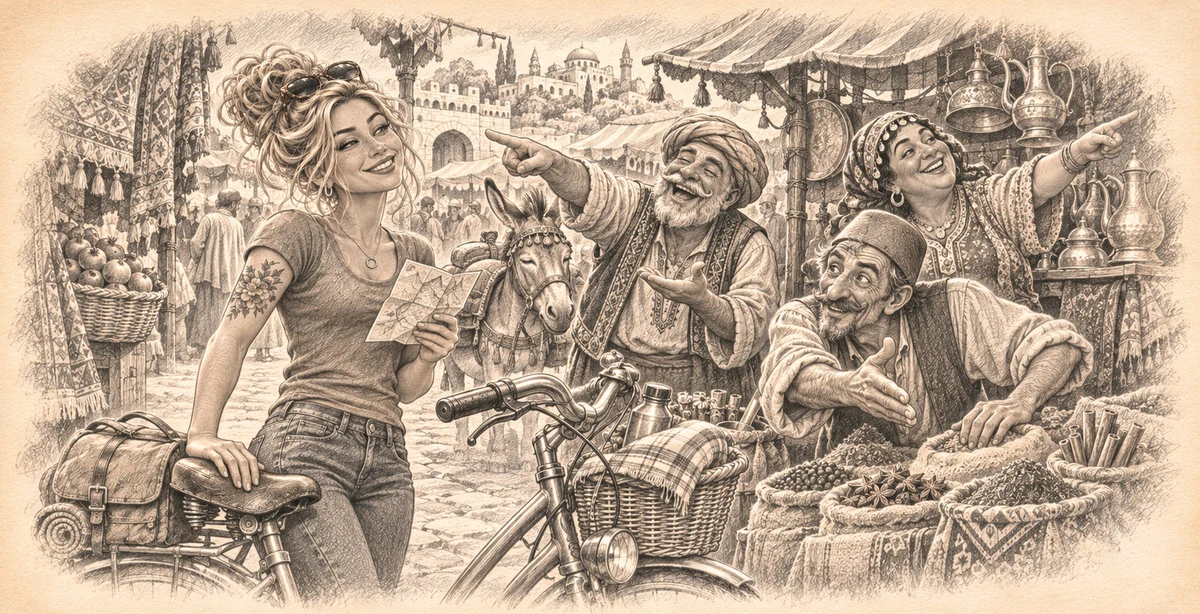
Blitzy began combining the instructions. She took the fruit seller's first fountain, the carpet seller's tower and the old man's spiral. The result led her through an alley where potters stacked their wares, across a little square and beneath a balcony from which washing hung like festival bunting.
The scent of bread grew stronger.
Then she lost it again when a coffee roaster opened his door.
Blitzy stopped. Coffee was not on the list. On the other hand, the list was now a stamped travel document, and travel documents had to allow a certain amount of freedom.
The roaster set a tiny cup before her. The coffee was so strong that, for one moment, Blitzy remembered events that had not happened yet.
"Bakery?" she asked.
The man pointed to the donkey, which had suddenly appeared at the end of the alley. A basket full of flour hung from its harness.
Blitzy followed it.
The donkey walked slowly but with purpose. It turned left twice, right once, and stopped before an unassuming wooden door. Baking trays clattered behind it. Warm air drifted through a crack, carrying the clear and unmistakable scent of fresh bread.
Blitzy laid a hand over her heart. "You are a professional."
The donkey accepted the compliment without appearing modest.
VII.
The Baker Behind the Blue Door
The bakery was small and hot. Baskets lined the walls, flat rounds of dough lay on a table, and a woman with silver hair and powerful arms worked in front of the oven.
Blitzy held up the note. "Two bread rolls."
The baker did not understand the words, but she understood the number. Blitzy raised two fingers and shaped something round with her hands. The baker placed two small loaves on the table. Blitzy nodded enthusiastically.
Then she pointed to the line about butter. This exchange took longer. It involved a cow, a spreading motion and a depiction of special offers that consisted mostly of Blitzy shrugging and pointing questioningly at her coins.
The baker laughed, wrapped a piece of salted butter and took exactly the coins Blitzy possessed. Then she gave her a third flatbread, still warm, for the journey.
Blitzy put it into the bicycle basket. Steam rose between the spokes.
"The ferry?" she asked, drawing a ship in the air.
The baker took the paper bag and drew a map on it with charcoal. The line ran through the market, over a bridge and along the sea. At the edge she drew a shell.
Blitzy thanked her. The baker pointed at the bicycle, then at Blitzy, then at the setting sun. Her face said plainly: Go. Now.
For the first time that day, Blitzy regarded directions as urgent.
VIII.
The Bridge of Goats
The map on the bag was precise, provided one accepted that houses were triangles and roads were snakes. Blitzy found the bridge. She also found the goats standing on it.
There were seven of them. They did not form a herd so much as an administration. The largest goat stood in the middle and controlled passage.
Blitzy rang her bell. Nothing happened.
She pushed the bicycle closer. The goat looked at her. Blitzy looked back.
"I have to get to the ferry."
The goat chewed.
Blitzy displayed the stamped shopping list. The goat remained unimpressed. Then it noticed the warm flatbread in the basket.
"That's for the journey."
The goat placed one hoof forward.
Negotiations followed for which no diplomatic handbook had made provision. Blitzy surrendered a small edge of the flatbread. The largest goat tasted it. Then it stepped aside. The other goats followed its example, though only after each had received an even smaller piece.
Blitzy crossed the bridge with considerably lighter travel provisions.
At the far end, she turned around. The largest goat had resumed its position in the middle and was watching her leave.
"Highway robbery," said Blitzy.
The goat chewed.
IX.
Against the Clock
At the harbour, the ferry's ramp was already halfway up.
Blitzy emerged from the final alley, saw the ship and pushed hard on the pedals. The basket bounced over the cobbles, the loaves jumped inside their bag, and her ring pendant struck her shirt. The ferryman stood at the top of the ramp and raised one hand.
For one terrible moment, Blitzy thought he was waving goodbye.
Then he shouted something the wind carried away and pointed to the narrowing gap.
Blitzy took a run at it.
It was not a leap across an abyss. It was perhaps thirty centimetres. In Blitzy's later recollections, those thirty centimetres became two metres, then three, and eventually a storm front played an important role. In reality, the front wheel rolled over the edge, a sailor seized the luggage rack, and Blitzy was standing on the ramp.
"On time," said the ferryman.
"Nearly."
He took the shopping list, added a third stamp and handed it back.
"What does that one mean?"
"Return passage with baked goods."
Blitzy rested the bicycle against the rail. The foreign coast slid away. In the basket lay two loaves, a partly eaten flatbread and butter that, surprisingly, had been on offer.
The mission was complete.
Almost.
X.
The Night Crossing
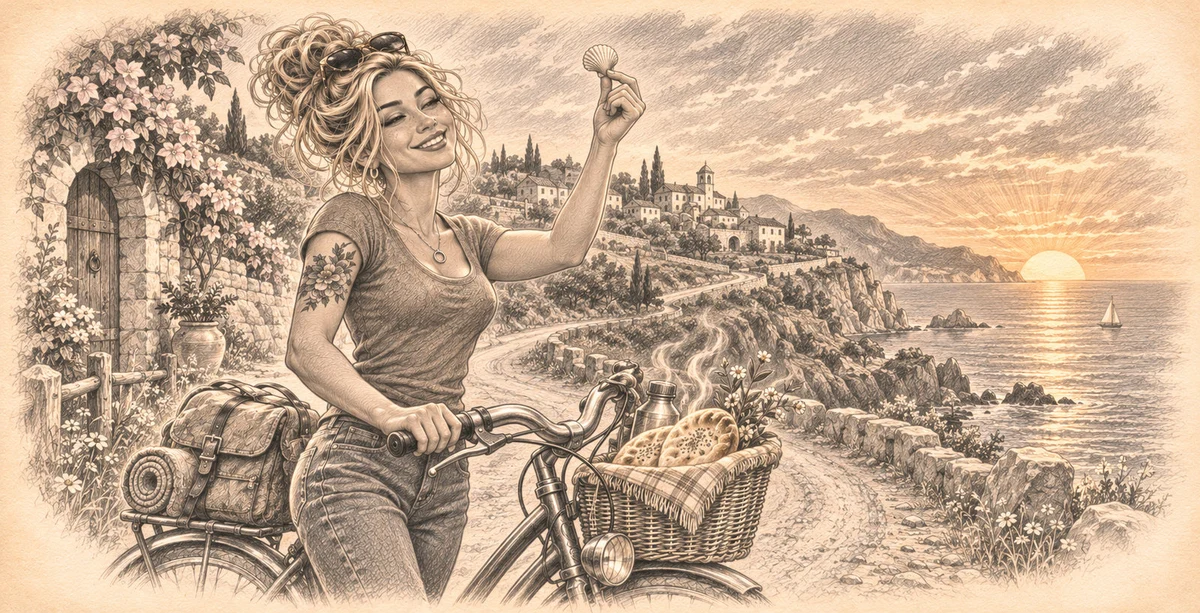
On the return journey, the sea grew dark. Lights appeared along the coast, first alone, then in chains. The passengers became quieter. Even the gulls had finished work for the day.
Blitzy sat on a bench beside her bicycle and ate the last piece of her travel provisions. The sailor with the stopwatch sat down next to her.
"Only going to the bakery?" he asked.
"Yes."
"Good bakery?"
Blitzy considered the bag. "Extensive catchment area."
The sailor nodded. After a while, he gave her a small shell he had found on the quay. Blitzy put it into her pocket. She thought about the morning, the bakery at the end of her street and the hole in the pavement. The day could have been over after four minutes. Instead, her shopping list bore three stamps and smelt of the sea.
She regretted nothing. She did, however, resolve to carry a little more money on future errands.
By the time the ferry reached the home harbour, night had fully fallen. The hill Blitzy had raced down that morning now awaited her in the opposite direction.
She stopped the bicycle at its foot and looked up.
"Of course," she said.
XI.
The Way Home Goes Up
Downhill, it had felt like freedom. Uphill, it was geography.
Blitzy pushed the bicycle at first. Then she rode for ten metres. Then she pushed again. The loaves sent their warm scent from the basket and reminded her with every step why she was there.
The moon hung above the fields. The morning's sheep now lay in the grass and watched Blitzy with the quiet approval possessed only by creatures that did not have to go uphill themselves.
Halfway up, she sat at the roadside. She took the shell from her pocket and held it to her ear. The rushing sound inside was suspiciously like the ferry.
A delivery van stopped. The driver knew Goldhain and offered to load her bicycle into the back. Blitzy thanked him, thought for a moment and declined.
"Why?" he asked.
She looked up the hill. "Because tomorrow I'll claim I made it all the way."
The driver accepted this. He gave her a bottle of water and drove on.
Blitzy reached the highest point shortly before midnight. Goldhain lay before her, silent and warmly lit. Naturally, the bakery at the end of the street was closed. The barrier had vanished. The hole in the pavement had been repaired.
There was no trace of the wooden arrow.
XII.
The Final Shortcut
At the edge of town, Blitzy could simply have followed the main road. She knew every lamppost, every pothole and the precise point at which one could smell the Goldhain bakery at night. But at the first junction stood a sign: ROAD CLOSED. NIGHT WORKS.
Beside it, a small arrow pointed into a side street.
Blitzy stopped. The arrow was official, neatly printed and entirely sensible. That was precisely why she distrusted it. She looked back at the long hill, then at the dark path running between the gardens.
"Just this one last shortcut," she said.
The path ended a hundred metres later at a locked garden gate. Behind it stood the workman from that morning. He carried a flask and guarded a patch of fresh tarmac that had grown to the size of a dining table.
"You were gone a long time," he said.
Blitzy rested the bicycle. "The diversion was international."
The man looked at the basket, the traces of sea salt on the frame and the three-times-stamped note in her hand. He decided against further questions. Instead, he opened the garden gate and led her through a narrow courtyard straight onto her street.
The bakery stood opposite, dark and silent. The moon was reflected in its window.
"The wooden arrow this morning," said Blitzy. "Who put it there?"
The workman unscrewed the lid of his flask. "What wooden arrow?"
Blitzy looked towards the rose arch. Only a length of string remained on the lamppost. She smiled. Some questions lost their value the moment one tried too hard to know the answer.
She wheeled the bicycle across the street. Now it truly was only a few metres.
Finale
Still Warm
A light was on in the kitchen. Three people sat at the table with empty plates and the kind of patience that eventually turns into scientific curiosity.
Blitzy opened the door, wheeled in the bicycle and placed the bag on the table.
"They were out of bread rolls," she said.
No one answered immediately.
She unpacked two flat loaves that remained slightly warm despite their long journey. Then the butter. Finally, she laid the stamped shopping list beside them.
"Is that an entry stamp?" someone asked.
"Technically, three of them."
Blitzy sat down, took the shell from her pocket and examined it in the kitchen light. Market dust clung to her sleeve, salt to her hair, and a leaf that did not grow in Goldhain had attached itself to the bicycle.
She cut open the first loaf. Steam rose from it.
"Was it worth it?"
Blitzy spread butter across the bread, took a bite and thought of the descent, the ferry, the donkey, the baker and the seven goats on the bridge.
"The detour was all right," she said.
The next morning, she fixed a small plaque above the bicycle. It read: BAKERY TRIPS ONLY.
Underneath, in smaller letters: PREFERABLY ON THE SAME CONTINENT.