Prologue
Just One Photograph
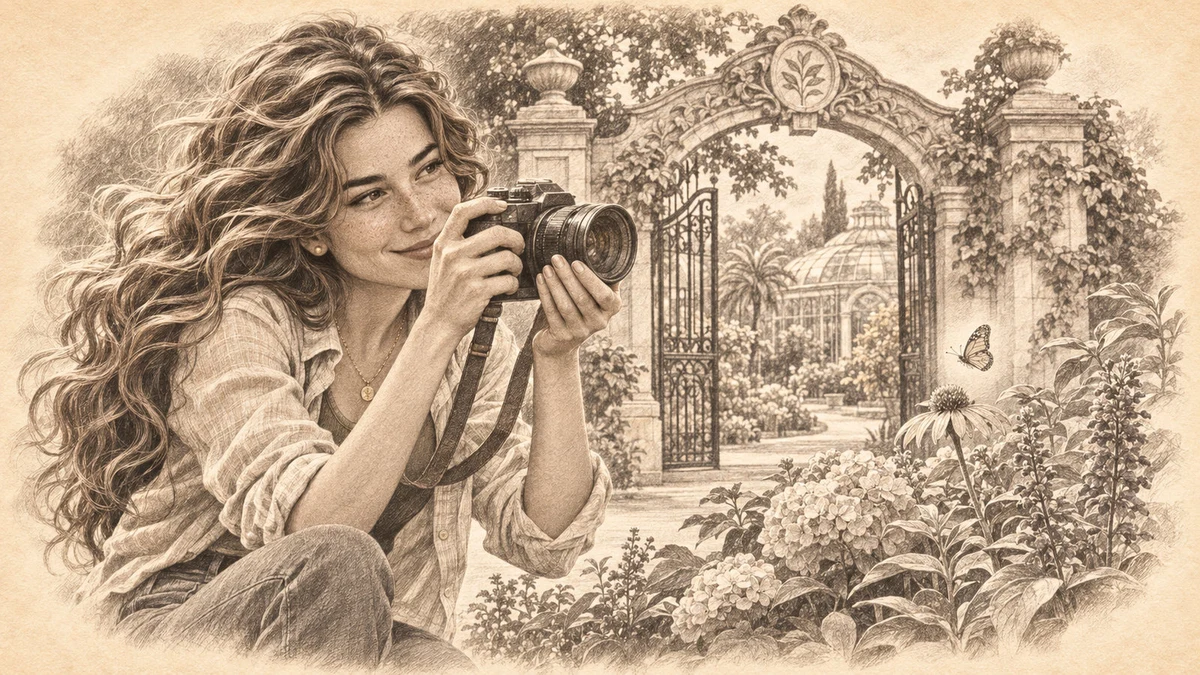
Mira wanted to take one photograph.
Not an award-winning photograph. Not a picture for an exhibition. Just a butterfly on a flower, sharp enough to show the fine lines of its wings and calm enough that the moment did not look like an escape.
Goldhain Botanical Garden opened at nine. Mira stood outside the gate at two minutes to nine. Her camera hung from her shoulder; her rucksack held water, an apple, a spare battery and a small cloth for the lens. Her long chestnut waves stirred in the morning wind.
Beyond the wrought-iron gate lay glasshouses, rose gardens and paths that disappeared between trees. For now, everything was still.
The gardener unlocked the gate. "Looking for anything in particular?"
Mira raised the camera. "Just one butterfly."
He nodded as though he often heard that sentence from people who later returned with muddy shoes and new questions about life.
"There are plenty in the herb garden today."
Mira went inside. A butterfly was sitting on the first flower beyond the gate.
It opened its wings. Perfect light, peaceful background, not a movement.
Mira lifted the camera.
The butterfly flew away.
And so the expedition began.
I.
The First Beat of Wings
Mira did not follow at once. Good nature photography consisted, to a considerable degree, of not running after things that possessed wings.
She waited.
The butterfly landed on lavender, opened its wings and remained there for precisely as long as it took the autofocus to find its face. Then it moved to the next plant.
Mira took a picture. It contained one flower, half a wing and a great deal of air.
She took a second. This time the butterfly was sharp, but a sign reading PLEASE KEEP OFF loomed larger in the background than anything else.
On the third, a bumblebee flew through the frame. On the fourth, a visitor in a sun hat stepped between the camera and the flower. On the fifth, everything was perfect until Mira noticed that the butterfly had closed its wings and looked like a dry leaf.
"You don't have to pose," she said softly. "Just stay for a moment."
The butterfly took off and flew over the low hedge.
Beyond it began the rose garden.
Mira checked the battery. Ninety-nine per cent.
She carried on.
At the end of the herb path, she stopped once more. The garden map showed a direct route to the butterfly house. Mira folded it, put it away and instead took the narrow path the butterfly had chosen. It passed beneath a trellis, by a bed full of sage and towards a little gate that squeaked quietly in the wind.
Behind her, the gardener called, "The butterfly house is the other way!"
"I know!"
It was the moment when a visit became a pursuit, though Mira still refused to use the word. Pursuits were noisy. She herself was merely taking a very purposeful walk.
II.
The Rose Labyrinth
On the map, the rose garden was a simple circle. In reality, it consisted of arches, hedges and paths woven together so skilfully that after three turns you found yourself greeting the same bench from a different side.
The butterfly flew low over the roses. Mira followed on the gravel path without stepping into the beds. Whenever it landed, a blossom stood in the way. Every clear line of sight pointed straight into the sun.
She knelt, stood, took two steps left and one back. An elderly visitor watched her.
"Yoga?" she asked.
"Photography."
"More strenuous?"
Mira looked at the butterfly gliding effortlessly over the hedge. "Today, yes."
She found the exit only when the gardener pushed a cart through a hidden gap. The butterfly was sitting on his straw hat.
Mira slowly raised the camera.
The gardener sneezed.
The butterfly rose, circled once over the cart and flew through the open door of the fern house.
The gardener watched it go. "It likes humidity."
"Apparently, so do I," said Mira, and followed.
III.
The Fern Forest
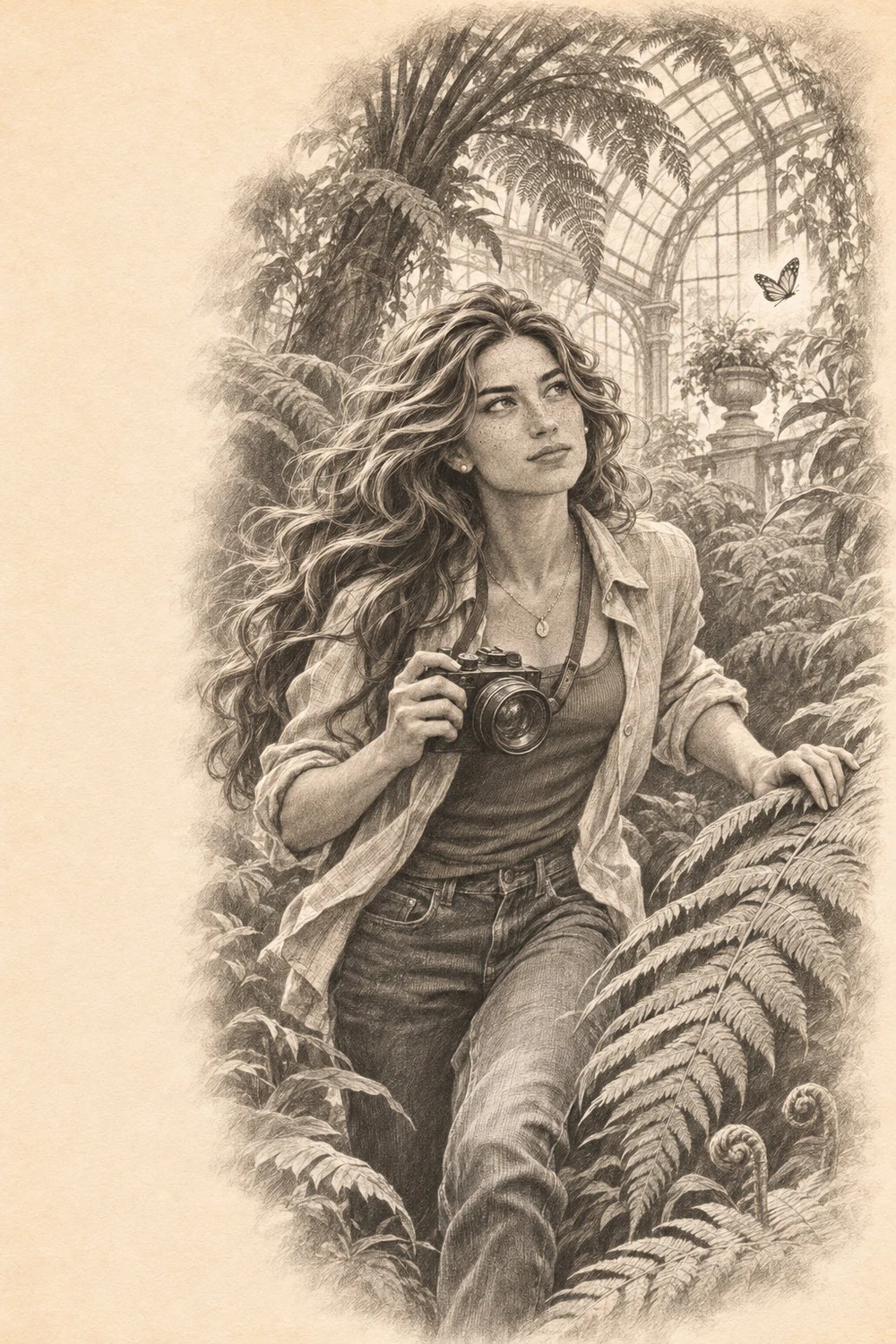
Inside the fern house, the air was warm and green. Water dripped from leaves, glass panes misted over, and paths vanished among plants that looked older than human resolutions.
Mira dried the lens. The butterfly was nowhere to be seen.
She walked slowly. Her shoes sank into the soft moss at the edge of the path. Fern fronds brushed her sleeves. A little stream crossed the path and ran beneath a stone bridge.
Then she saw movement: a wing between two leaves.
Mira lifted a fern frond with her left hand and held the camera in her right. The butterfly sat on a pale flower. Behind it was nothing but dark green. Light fell through the roof as though into a tall cathedral.
She focused.
A drop fell from the fern directly onto the lens.
Mira pressed the shutter anyway. The photograph showed a beautiful, soft circle of light and, somewhere behind it, something that might have been a butterfly.
She smiled. Not the picture. But a good mishap.
The butterfly flew deeper into the fern forest.
Mira followed it across the bridge.
IV.
The Expedition Grows
At a quarter to eleven, Lena called.
"Are you still in the garden?"
"Yes."
"Have you got the picture?"
Mira looked at the butterfly dancing over water lilies at the other end of the pond. "Almost."
The word almost was dangerous on expeditions. It seldom meant closeness. Usually, it meant that you had already invested too much to turn back sensibly.
Mira sent her location. On the map, she was three hundred metres from the entrance. The route her phone had recorded was nearly three kilometres long.
Lena replied with a single question mark. Mira sent a picture of the water lilies. Lena sent two question marks. At last, Mira wrote: The route is botanically longer than it is geographically.
This explanation was accepted because, in Goldhain, it sounded more plausible than many official distance measurements.
A group of hikers sat at the other end of the bench. They carried poles, maps and heavy rucksacks, though they were only heading for the alpine garden. One asked whether Mira was also on a long-distance walk.
"As far as the tropical house," she said.
He inspected her muddy knees and nodded respectfully. "Challenging route."
She ate the apple on a bench and reviewed the pictures she had taken. Roses without a butterfly. Butterfly without a head. Head without focus. One complete butterfly behind the knee of an unknown visitor.
None was the one picture.
At the pond, the butterfly landed on a water lily. Mira stood. At that exact moment, a gardener's boat rounded the corner, small and slow but positioned precisely in the background of the shot.
The man in the boat raised a hand.
Mira waved back.
The butterfly flew towards the tropical house.
V.
The Glass Pass
The tropical house contained three climate zones and a door that opened only when the previous one had closed.
Mira entered the airlock. The door shut behind her. Nothing opened in front.
A sign requested patience. Mira waited. A fine mist sprayed her hair. The camera fogged up again. After a minute, the inner door opened with a sigh.
Heat struck her.
The butterfly flew above banana leaves, orchids and a small waterfall. Here, it was no longer alone. Dozens of others fluttered through the air. Blue, yellow, white and dark wings crossed paths.
Mira stopped.
Now the difficulty was not finding a butterfly. It was recognising hers.
It had a small notch in its left wing. Mira searched among the movement. A blue butterfly landed on her shoulder. A white one settled on the camera strap. The one she sought flew above the waterfall.
She followed it up a staircase, through a tunnel of leaves and onto a platform overlooking the tropical pond.
Three tripods stood on the platform. A group of serious photographers were waiting for a rare blue butterfly. Each carried a lens longer than Mira's forearm. They whispered about shutter speeds.
The rare blue butterfly landed unnoticed on the smallest photographer's rucksack. Mira pointed carefully. No one moved. For one perfect moment, they communicated only with their eyes.
Then a phone rang somewhere. The blue butterfly took off, the group sighed together, and Mira's butterfly used the confusion to cross the signpost.
"Yours?" asked one photographer.
Mira nodded.
"Persistent."
"Both of us."
The sign pointed left towards the exit.
The butterfly flew right, where there was no arrow.
VI.
Beyond the Signpost
To the right, a narrow maintenance path followed the glass wall. It was open to visitors but so inconspicuous that no one used it.
Mira walked along it. Behind the large plants, everything grew quiet. The roar of the waterfall receded. Only the click of her shoes and the soft beat of wings accompanied her.
The path led to a door outside. Beyond it lay a part of the garden Mira had never seen: a meadow of wild flowers surrounded by old walls. No sign, no bench, no straight path.
The butterfly settled on a thistle.
Mira crouched. The background was calm, the light soft, the distance perfect. She raised the camera in both hands and breathed out.
Just before she pressed the shutter, a second butterfly landed beside it.
Then a third.
Within seconds, the thistle was full of wings. The one clear subject became a swarm.
Mira lowered the camera and had to laugh.
A gardener working at the far end of the meadow looked over. "They all come here at midday."
"Of course they do," said Mira.
The butterfly she was following detached itself from the group and flew on.
VII.
The Mountain Garden
Beyond the meadow, the ground began to rise.
The mountain garden was a miniature landscape of rocks, low pines and small streams. On the map, it looked like a hill. From below, it resembled a mountain range, especially to someone who had already spent four hours at butterfly height.
Mira followed the steps. The camera strap pressed into her shoulder, the spare battery was now in use, and the final sip of water became a decision.
The butterfly flew effortlessly upwards.
"That is unfair," said Mira.
Halfway up, she met a school class. The children were collecting leaf shapes. One spotted the butterfly and shouted so loudly that it flew three rocks farther on.
Mira explained why it was best to approach slowly. The children instantly became a silent expedition unit. With solemn faces, they indicated every change in flight direction.
Together, they reached the viewpoint. There, the butterfly landed on a small sign.
The children arranged themselves in a semicircle. One girl held a branch aside, a boy shaded the light with his cap, and the teacher stood on the path informing passing visitors that a scientific image was being recorded.
Mira wanted to object, but the group's seriousness was too touching. She showed the children how to look through the viewfinder without touching the camera. Each noticed something different: the notch in the wing, an ant on the sign, a cloud above the glasshouse.
When the butterfly moved on, the class drew its route in arrows on their worksheet. An exercise about leaf shapes became an expedition with its own situation map.
Mira focused.
The sign read ENJOY THE VIEW and filled the entire picture.
The children giggled silently.
Mira pressed the shutter. She kept that picture.
VIII.
False Perfection
At the viewpoint, she finally captured a technically perfect image.
The butterfly sat on a white flower. Its wings were open, the notch visible, the background soft. Exposure, focus and composition were all correct.
Mira studied the display.
Something was missing.
The picture was correct. It showed exactly what she had wanted that morning. And yet the butterfly looked like an object in it, neatly placed and cleanly recorded. Nothing recalled the rose garden, the drop on the lens or the children holding their breath.
"Is that it?" one of the children asked.
Mira hesitated. "It's a good photograph."
"But not the photograph?"
Children understood dangerously quickly.
The butterfly flew away. Mira let it go. For the first time that day, she did not immediately follow.
She sat on the rock and looked out over the valley of the garden. The glasshouses glittered, paths crossed, and somewhere below lay the entrance.
Then she saw the butterfly again. It was not leaving. It waited on a branch below the path.
Mira stood.
IX.
The Storm
Clouds gathered above Goldhain.
The wind arrived first. Leaves turned their pale undersides upwards, glasshouse doors were closed, and gardeners collected signs. Visitors headed for the exit.
Mira was at the far end of the garden.
The first raindrop struck her hand. She pulled the camera beneath her blouse and ran to the nearest shelter, a small pavilion by the lily pond. The butterfly flew there too and settled beneath the roof beams.
Then the rain broke.
Water roared over the leaves. A thousand little circles covered the pond. Mira and the butterfly waited side by side, separated by two metres and a very different relationship with moisture.
Mira did not take a photograph. The light was dark, the angle poor and the moment too peaceful to interrupt with a shutter.
She sat on the bench. The butterfly slowly opened and closed its wings.
"We could both have stopped earlier," said Mira.
The rain answered for it.
X.
Holding Still
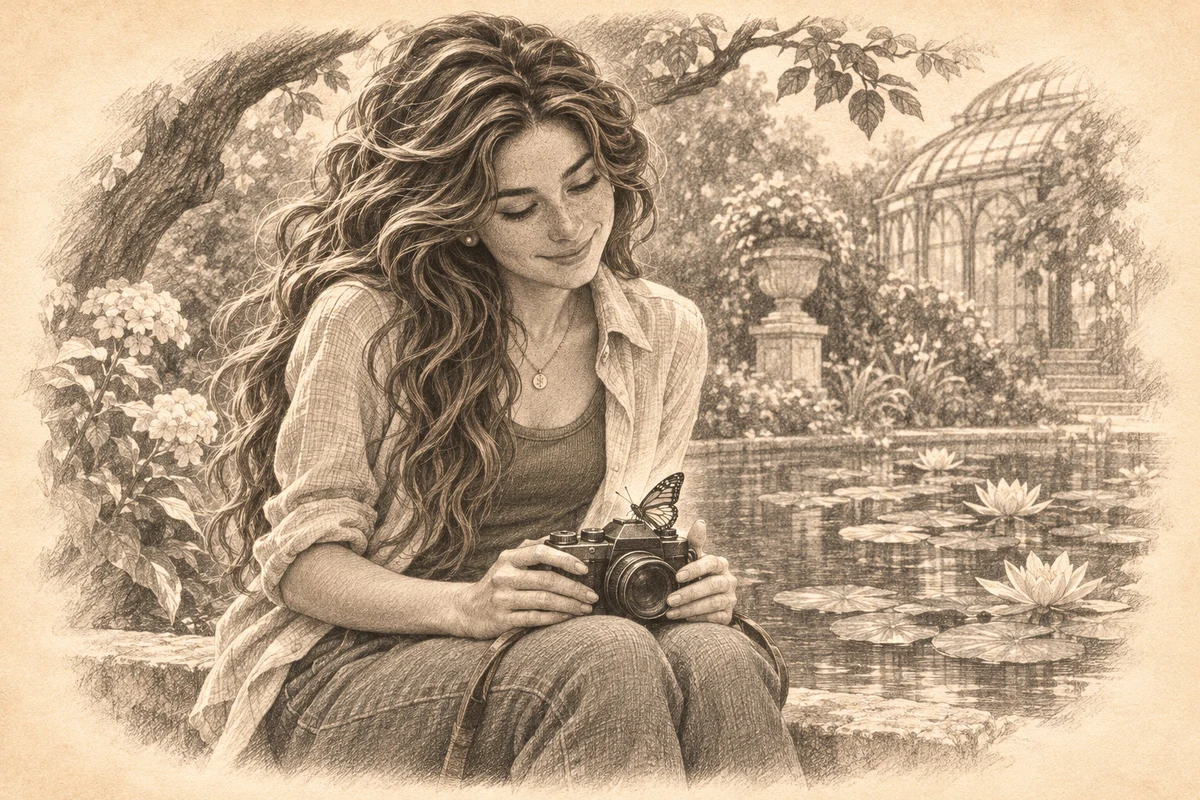
After twenty minutes, the rain weakened.
Mira placed the camera in her lap and checked the lens. Dry. The butterfly left the beam, flew a small circle and landed on top of the camera.
Mira froze.
Its feet were so light that she barely felt them. The wings opened. The little notch was directly in front of her.
She could not have used the camera even if she had wanted to. The subject was sitting on the tool.
So Mira remained still.
A gardener came along the path, saw the situation and stopped as well. Behind him waited a visitor with a pushchair. Then came a man carrying two cups of coffee. No one knew exactly what they were waiting for, but Mira's posture made it clear that movement was currently inappropriate.
Thus, a small silent queue formed beside the lily pond. The man with the coffees held his breath. The child in the pushchair slept on. The gardener slowly removed his cap so the wind would not move it.
For almost a minute, the butterfly held the undivided attention of seven people without asking anything of them.
The garden smelled of wet earth. Drops fell from the trees. In the pond, a water lily opened as though it had merely been waiting for the rain.
Mira looked at the butterfly, not through a lens. After all those kilometres, this was the closest moment of the day.
It stayed for almost a minute.
Then it took off and settled on a flower at the edge of the pond.
Mira raised the camera. No hurry. No pursuit. She waited for it to open its wings.
One quiet click.
XI.
The Picture
The photograph was not perfect.
A raindrop hung from the edge of the flower. A leaf in the background was brighter than planned. The butterfly was not precisely in the centre, and one wing was a breath less sharp than the other.
But the picture held the stillness after the storm. You could see that the butterfly was about to move on. The notch in its wing did not make it flawed, but unmistakable.
Mira looked at it for a long time.
Then she switched off the camera.
She took no more photographs on the way back. She walked through the mountain garden, the wild meadow and the tropical house. The school class waved to her at the exit. The gardener from the rose garden asked whether she had found her subject.
"Yes," said Mira.
"Was it difficult?"
She looked at her muddy shoes, the empty water pouch and the misted lens. "Just a little walk."
The gardener nodded. He probably heard that sentence often as well, from people who left the garden differently from how they had entered it.
XII.
The Selection
At home, Mira transferred the pictures.
There were three hundred and forty-eight files. Among them were eleven empty flowers, seven visitors' knees, four bumblebees, one gardener's hat and a potato whose origin no one could explain.
The technically perfect image was number two hundred and nine. The picture after the rain was number three hundred and forty.
Mira opened them side by side.
She enlarged both. In the perfect photograph, every scale on the wings could be counted. In the other, a tiny patch of bright sky was reflected in the raindrop. A bench could be seen in the background, and on it lay her folded garden map.
The first picture explained the butterfly. The second brought back the day.
She printed both as a test and put them against the wall. After ten minutes, she saw only the picture after the rain. The other was beautiful, but still in a way that left nothing open.
The perfect picture was clearer. The other was more alive.
She chose the second.
Not for an exhibition. Not for a competition. She printed it small and placed it beside her pot of herbs. Beneath it, she wrote only the date.
Lena studied the photograph. "The left wing is slightly out of focus."
Mira smiled. "It was just about to leave."
Lena looked again. "Then it fits."
Mira kept the other pictures too. Even the one with the ENJOY THE VIEW sign. Especially that one.
An expedition consisted of more than its destination. Sometimes, the blurred parts were proof that you had really been there.
Finale
A Quiet Wing
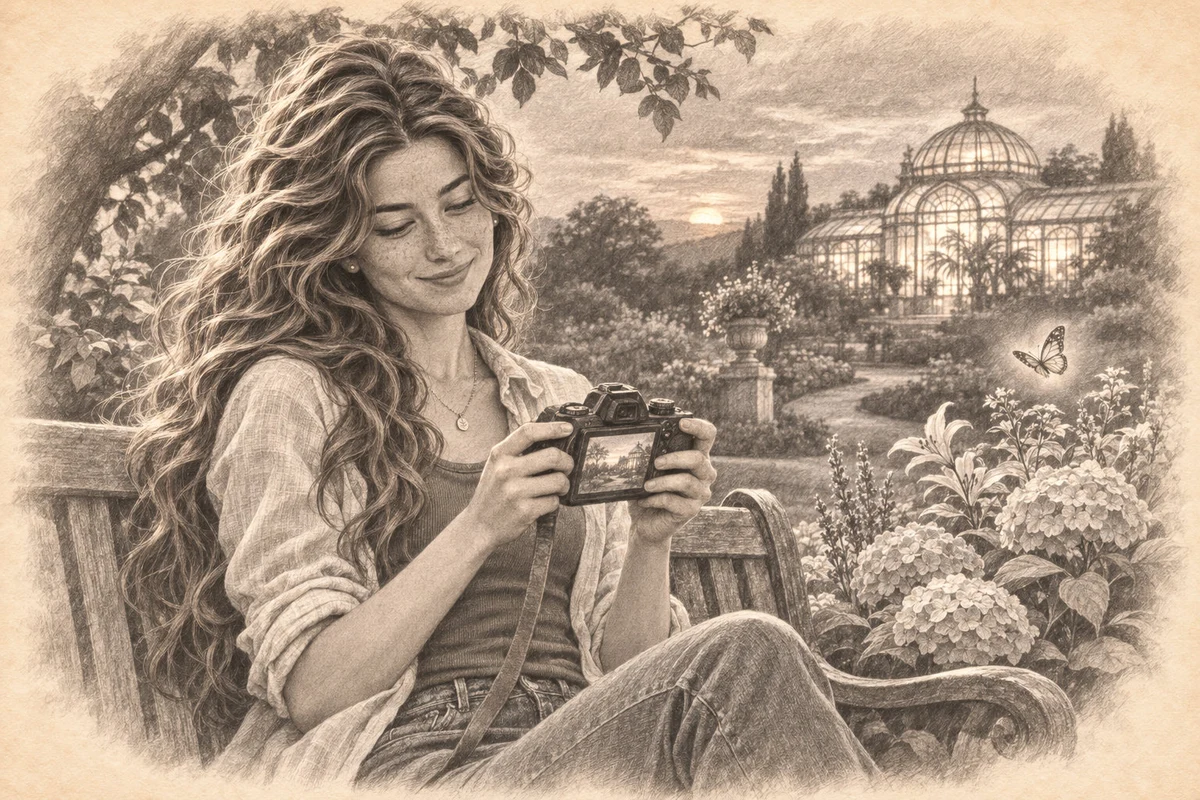
One week later, Mira returned to the botanical garden.
The gardener at the gate recognised her. "Just one butterfly again today?"
"None today."
He glanced at the camera on her shoulder.
"Just in case," Mira added.
He handed her a freshly printed map of the garden. Someone had marked the route from the entrance to the lily pond in red. The line was short and direct. Mira put the map away, turned left behind the herb garden and took the longer path through the roses.
Without a spare battery, without a route plan and without the intention of making one particular picture. She brought the camera anyway. Some habits were not a burden.
At the lily pond, she sat on the same bench. The sun was low, the glasshouse glowed in the evening light, and several butterflies flew over the flowers.
Perhaps her butterfly was among them. Perhaps not.
Mira raised the camera, took a picture of the garden and studied it. No butterfly in the image was sharp. One passed through the edge as nothing more than a pale wing.
She kept it.
Then she set the camera beside her and simply watched.
A small butterfly landed on the back of the bench. Mira did not move. It stayed, opened its wings and flew away again.
No click followed it.
Mira smiled.
Some pictures did not need to enter a camera in order to remain.
And some paths were right precisely because they took longer.